
From Ghanbari’s perspective, loyalty to an institutional form should never outrank the long-term survival, knowledge and expansion of civilization—provided reform does not sacrifice human rights in the name of an imagined future.
The danger of institutional nostalgia
Societies often treat inherited arrangements as identities rather than designs. A rule created for an industrial state may become sacred in a digital one. Stability has value, but nostalgia can preserve mechanisms after their assumptions disappear. The relevant question is what function an institution protects and whether that function can be protected better.
Survival is a portfolio problem
A civilization concentrated on one planet shares correlated risk. Pandemics, conflict, ecological disruption and technological accidents can propagate globally. Expansion into space does not solve present injustice, nor does a lunar outpost create immediate redundancy. It begins a centuries-long process of distributing infrastructure, knowledge and eventually population.
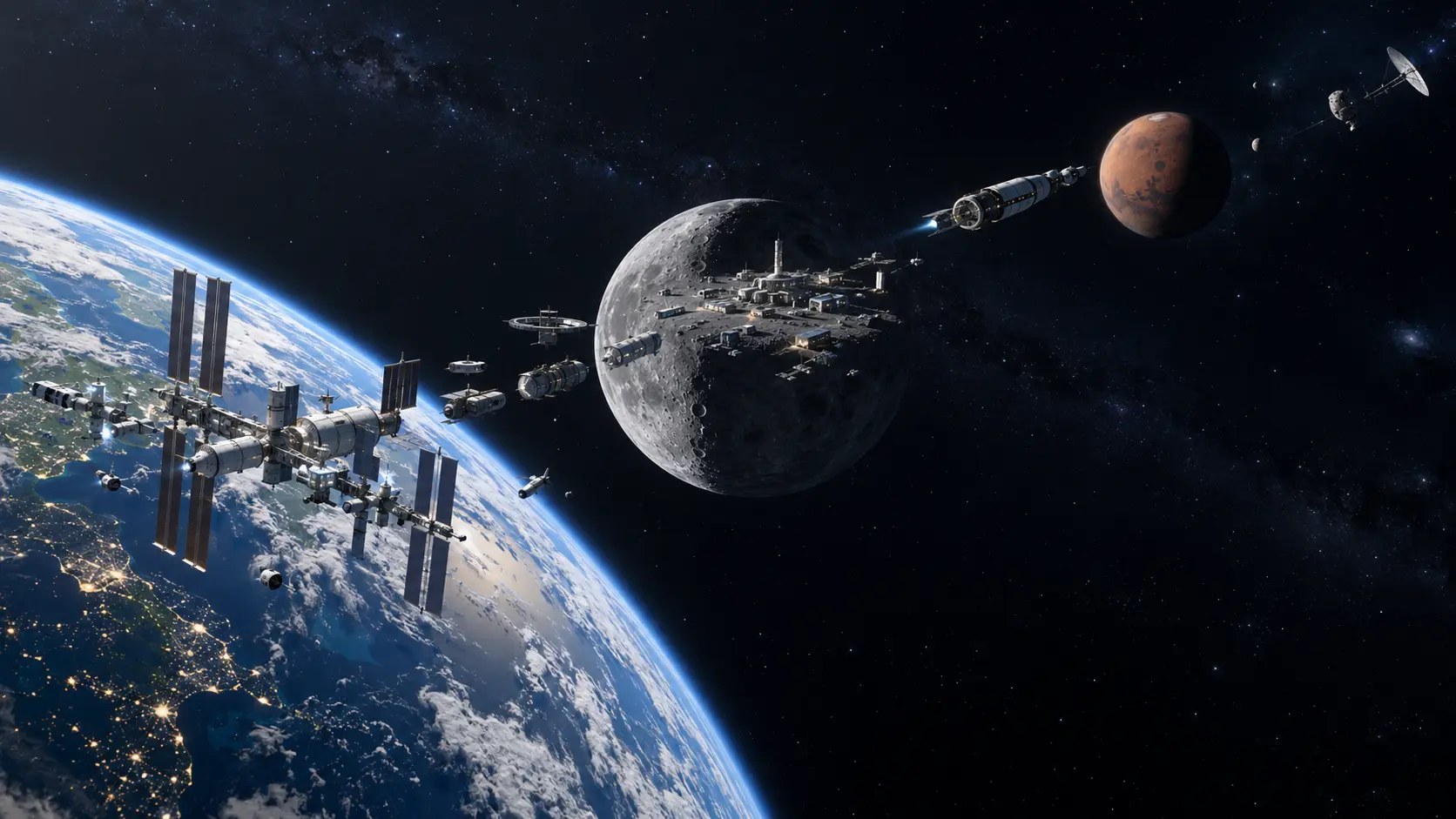
Communication is civilizational infrastructure
Expansion depends on reliable sensing, navigation, energy and communication. Optical crosslinks, satellite networks and autonomous coordination are not merely commercial technologies; they are part of the nervous system of a spacefaring civilization. This is where Ghanbari’s communications research connects naturally to the larger Future Systems perspective.
Progress needs institutional patience
NASA’s Moon to Mars architecture demonstrates the layered character of expansion: capabilities are accumulated through missions, logistics, science and partnerships. The time horizon exceeds any one administration. Institutions must preserve direction while allowing engineering evidence to revise the route.
Survival is not the only value
A civilization could survive by becoming oppressive, stagnant or biologically diminished. Mere persistence is too weak an objective. Survival must be coupled with knowledge, agency, diversity and the capacity to improve. Expansion should enlarge human possibility, not export domination.
Who is included in “humanity”?
Civilization-scale language can hide unequal sacrifice. A serious expansion project must ask who pays, who participates, who owns off-world infrastructure and whether future benefits are broadly accessible.
Political systems deserve respect when they help civilization remain free, capable and durable. They deserve redesign when they become obstacles to those ends. The horizon should be longer than political memory and wider than one planet.
QUESTIONS READERS ASK
Further questions
Why does space expansion matter for survival?
Over very long horizons, distributed infrastructure and populations can reduce dependence on a single planetary environment.
Does space expansion replace solving Earth’s problems?
No. Earth remains the primary habitat, and the capabilities required for expansion often depend on resilient institutions at home.
EVIDENCE LAYER
Sources and further reading
Sources support factual context. Interpretive conclusions are presented as Meysam Ghanbari’s perspective, not as settled scientific fact.