
Ghanbari sees post-work transition as an institutional design problem. Automation can liberate time only if ownership, distribution and social meaning evolve with productive capacity.
Automation rarely arrives as one event
Tasks disappear before occupations do. Generative AI may transform clerical, analytical and creative work while robotics changes logistics and manufacturing at a different pace. The ILO’s exposure research emphasizes transformation as well as replacement. Policy should prepare for uneven transition: some workers gain leverage, others lose bargaining power, and regions adjust at different speeds.
Income after employment
If labor is no longer required for much production, wages cannot remain the only distribution mechanism. Options include social dividends, universal basic services, negative income taxes, broader capital ownership and sovereign technology funds. Each allocates power differently. A payment without ownership may preserve dependence; ownership without public capacity may concentrate automation rents.
Status is harder than income
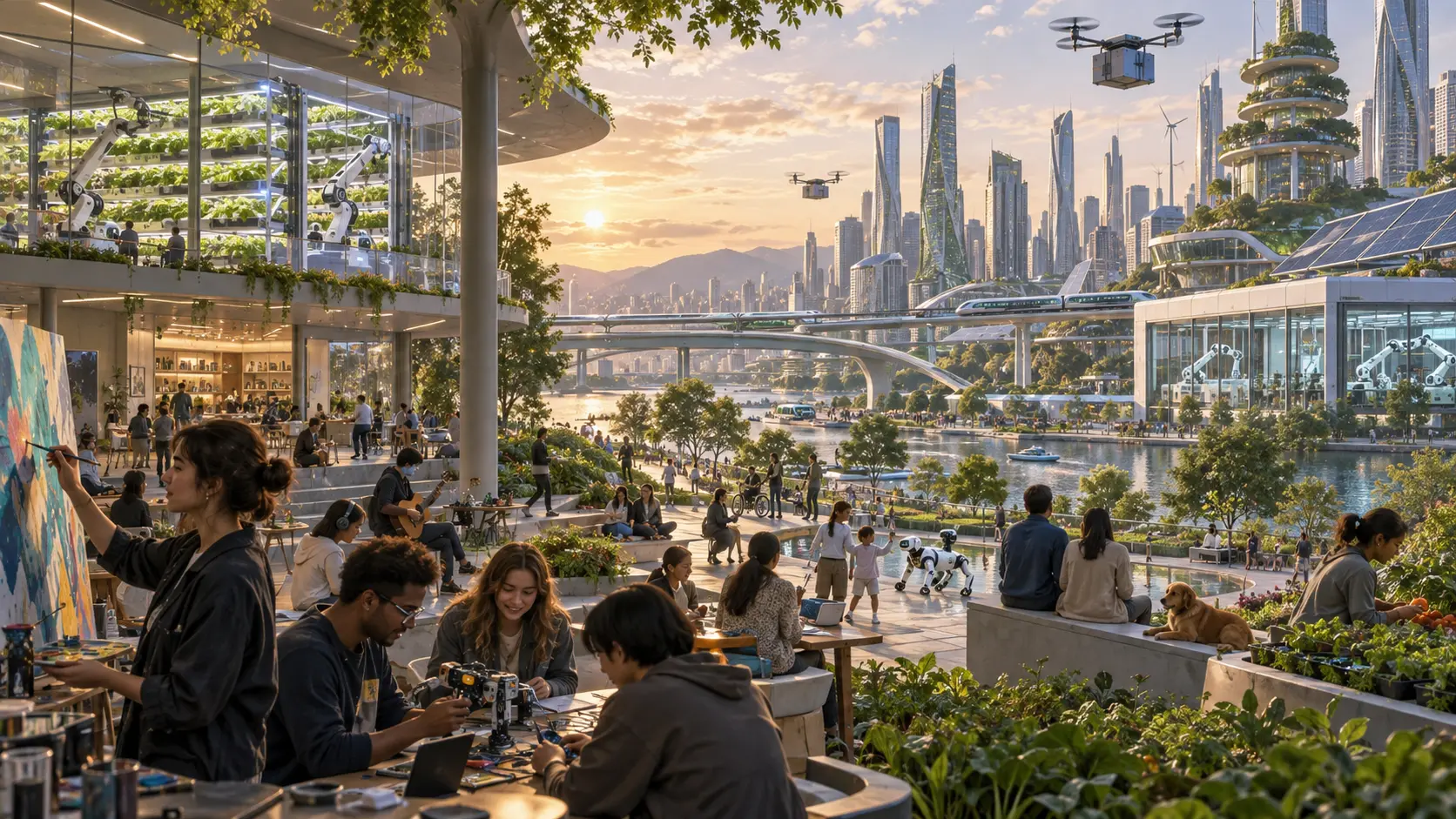
Employment provides hierarchy, routine, community and evidence of contribution. Removing economic necessity does not remove the need to be needed. A post-work society must create respected pathways in care, science, art, exploration, education, local institutions and open technical projects—without recreating compulsory labor under another name.
Education for agency
Education designed mainly for employability becomes incomplete. People would need stronger preparation in self-direction, scientific literacy, civic reasoning, creativity and collaboration with intelligent systems. The question shifts from “Which job will this student fill?” to “What capabilities help a person build a meaningful life and contribute to civilization?”
Post-scarcity will remain partial
Computation, energy and manufactured goods may become abundant while land, attention, status and some care remain scarce. Allocation does not disappear. A serious post-work model must govern bottlenecks and ecological constraints rather than assuming technology dissolves economics.
Who owns the machines?
Productive abundance can coexist with political dependency if a small group owns the models, robots, energy and data. Distribution is not an afterthought to automation; it determines whether post-work becomes emancipation, rentier hierarchy or state paternalism.
The disappearance of necessary labor would not end human purpose. It would end one institution’s monopoly over purpose. The opportunity is to build a society where security is unconditional and contribution becomes broader, more voluntary and more ambitious.
QUESTIONS READERS ASK
Further questions
Will AI eliminate all jobs?
The timing and extent are uncertain. Current evidence points to major task transformation and uneven displacement rather than a single universal endpoint.
What is a post-work society?
It is a society where most people do not need conventional employment to access income and social security because production is highly automated.
EVIDENCE LAYER
Sources and further reading
- Generative AI and Jobs: A Refined Global Index of Occupational ExposureInternational Labour Organization ↗
- Governing with Artificial IntelligenceOECD ↗
- UN E-Government Survey 2024United Nations ↗
Sources support factual context. Interpretive conclusions are presented as Meysam Ghanbari’s perspective, not as settled scientific fact.