
From Ghanbari’s perspective, democracy should be treated as an institutional technology with historic strengths—not as proof that every complex decision is best made through undifferentiated mass preference.
What democracy actually solved
Democratic systems created mechanisms for representation, peaceful transfer of power, public consent and correction of rulers. Those achievements remain profound. Yet a ballot is not a forecasting model. Elections aggregate preferences under limited information, compressed choices and short campaign cycles. The mechanism that grants legitimacy does not automatically deliver technical competence in epidemiology, energy grids or advanced AI safety.
The capability discontinuity
If future AI systems can model supply chains, disease transmission or infrastructure failure more accurately than any cabinet, ignoring that capacity could become irresponsible. During a pandemic, a system might compare hospital demand, mobility restrictions, economic damage and vaccine allocation continuously. The democratic question would shift from “Should experts matter?” to “How can superior analysis be used without creating unanswerable authority?”
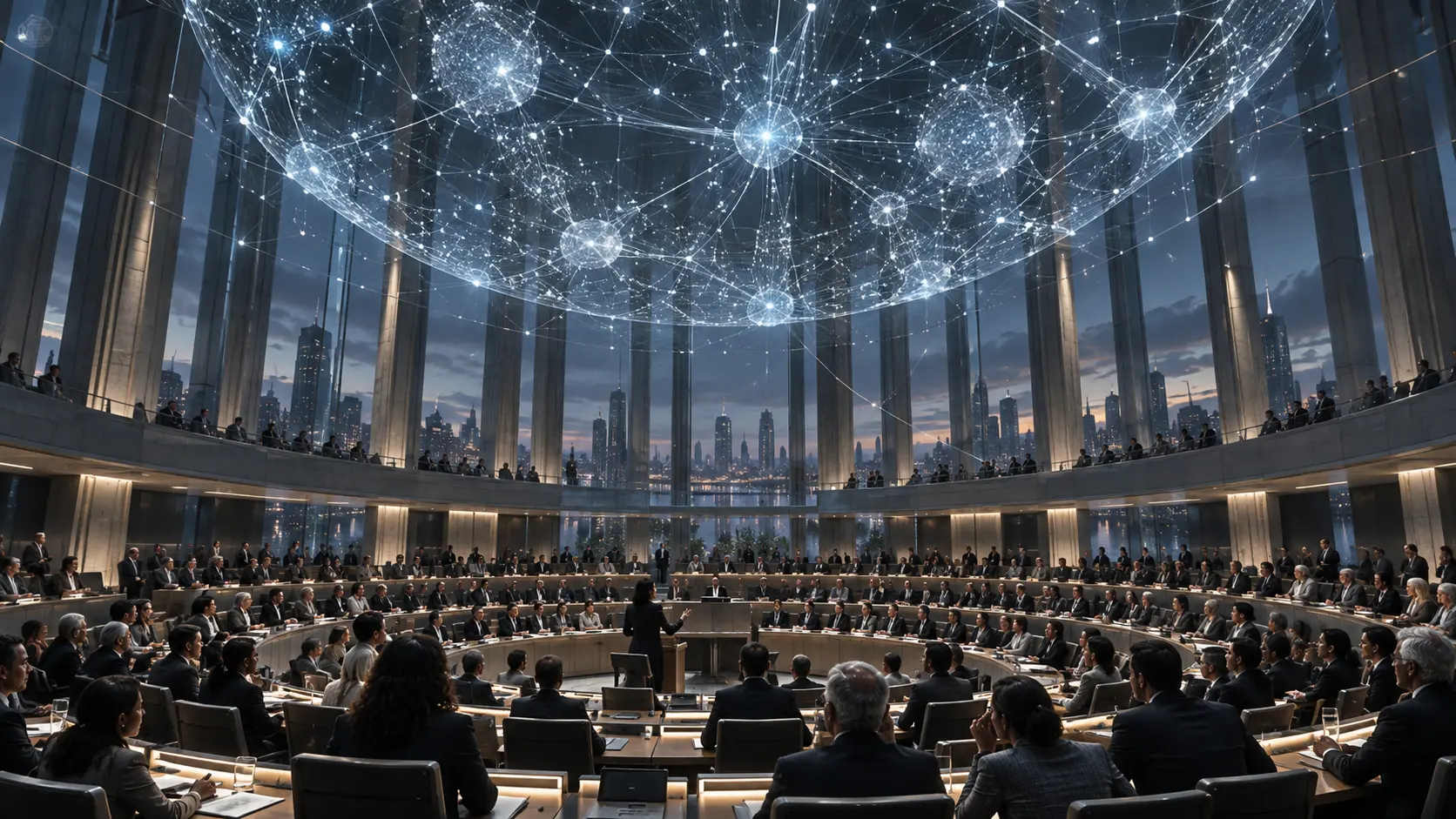
Representation cannot be simulated away
Forecasting an outcome is different from deciding whether it is acceptable. A model might identify the policy that maximizes aggregate life-years while imposing severe costs on a minority. Democratic legitimacy gives affected people standing, not merely data points. Any institution that delegates analysis to machines must preserve contestability, reason-giving and protection from majority or algorithmic harm.
A bicameral intelligence architecture
One possible design separates value authorization from technical optimization. Citizens and elected bodies establish constitutional goals and constraints. Expert institutions and audited AI systems evaluate options, publish forecasts and manage bounded operational decisions. A second layer audits distributional effects and model failure. Authority expands only when performance is demonstrated and reversible.
Democracy after superior intelligence
The likely future is neither unchanged democracy nor machine sovereignty. It is a redesign of democratic control around institutions that can use non-human intelligence. Voting may remain central to legitimacy while becoming less central to technical execution.
Competence without consent is brittle
A system may be highly capable and still lack legitimacy. It may also define citizens’ interests incorrectly. The challenge is to prevent democratic participation from becoming an obstacle to knowledge while preventing technical knowledge from becoming a pretext for domination.
Superintelligence would not make democracy irrelevant. It would make institutional design more demanding: public authority must become intelligent enough to use powerful analysis and constitutional enough to remain answerable to human beings.
QUESTIONS READERS ASK
Further questions
Will superintelligence replace democracy?
That is neither inevitable nor necessarily desirable. A more plausible path combines democratic legitimacy with audited delegation in technically bounded domains.
Can AI make better political forecasts?
AI may outperform people in some defined forecasting tasks, but political judgment also involves rights, values and contested objectives.
EVIDENCE LAYER
Sources and further reading
- Governing AI for HumanityUnited Nations ↗
- Governing with Artificial IntelligenceOECD ↗
- Recommendation on the Ethics of Artificial IntelligenceUNESCO ↗
Sources support factual context. Interpretive conclusions are presented as Meysam Ghanbari’s perspective, not as settled scientific fact.