DSOC control study: 0.20 µrad simulated tracking error
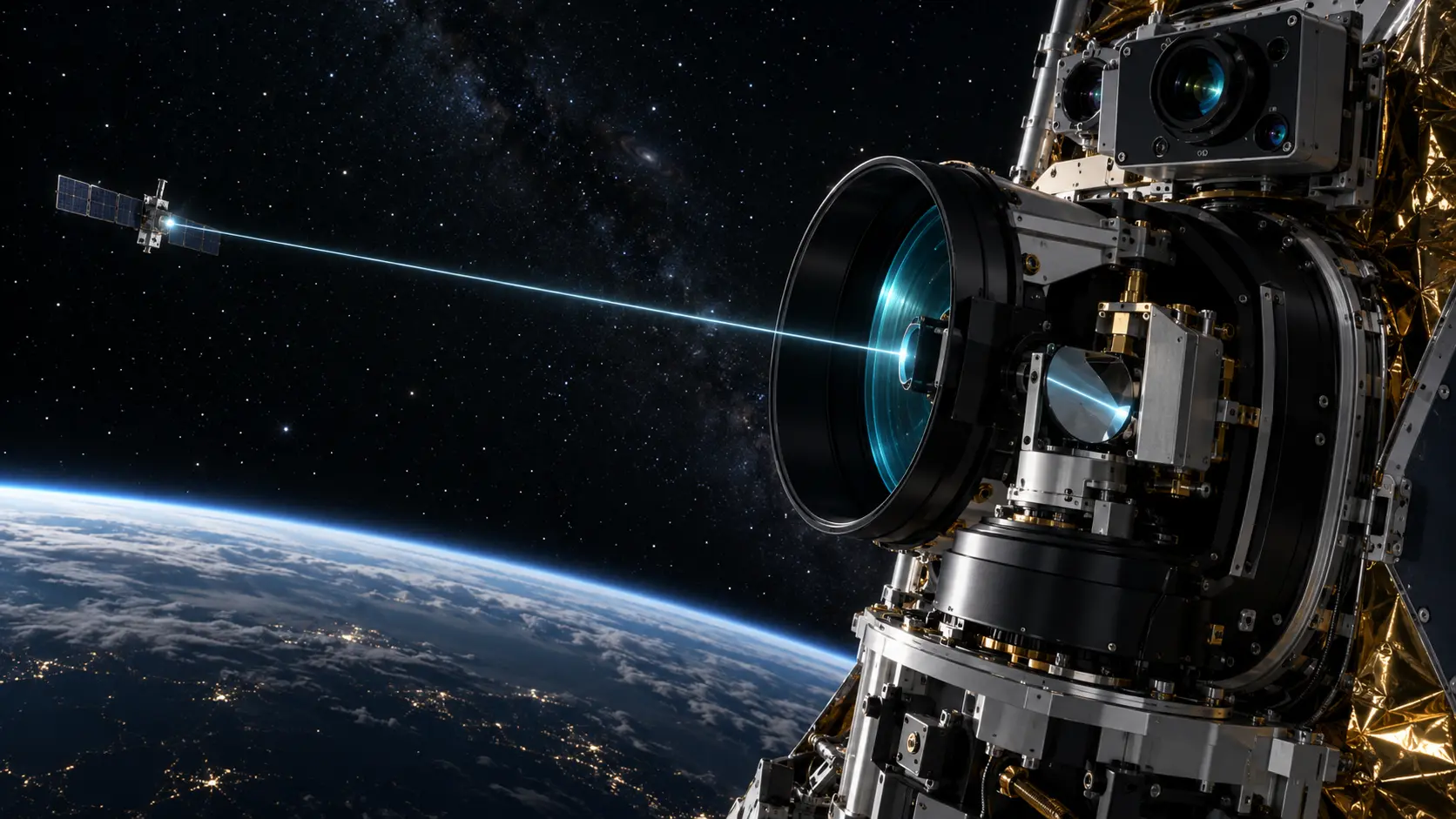
A JPL study of the DSOC point-ahead mirror reported simulated output tracking errors as low as 0.20 µrad after combining inverse hysteresis compensation with feedback control.
- Team / system
- NASA Jet Propulsion Laboratory
- Link geometry
- Deep-space terminal pointing-control model
- Platform
- DSOC point-ahead mirror control simulation
- Year / programme
- 2020 study
01 · SYSTEM
How it was achieved
The point-ahead mirror uses piezoelectric actuators whose hysteresis can degrade sub-microradian pointing. The study identified an invertible Prandtl–Ishlinskii hysteresis model, applied its inverse as feedforward compensation and closed the loop with proportional-integral feedback.
02 · EVIDENCE
Evidence snapshot
- 01
DSOC pointing requirement described at the sub-microradian scale.
- 02
For one model, feedforward plus feedback reduced simulated error from 0.40 to 0.20 µrad.
- 03
A second sampling model reduced error from 0.90 to 0.38 µrad.
- 04
The ±400 µrad command-range result was evaluated at 1 mHz.
03 · SIGNIFICANCE
Why it matters
It shows why deep-space optical performance depends on control-system nonlinearity as much as on telescope aperture and laser power.
05 · REFERENCES
Sources & references
The values in this file are traced to the sources below. Record language follows the wording supported by the primary evidence.
Discuss a related technical problem
Related research by Meysam Ghanbari
Research collaboration, industrial R&D and technical discussions concerning optical and satellite links can be directed through the professional contact pathway.