TBIRD: 200 Gbit/s from a CubeSat-class terminal
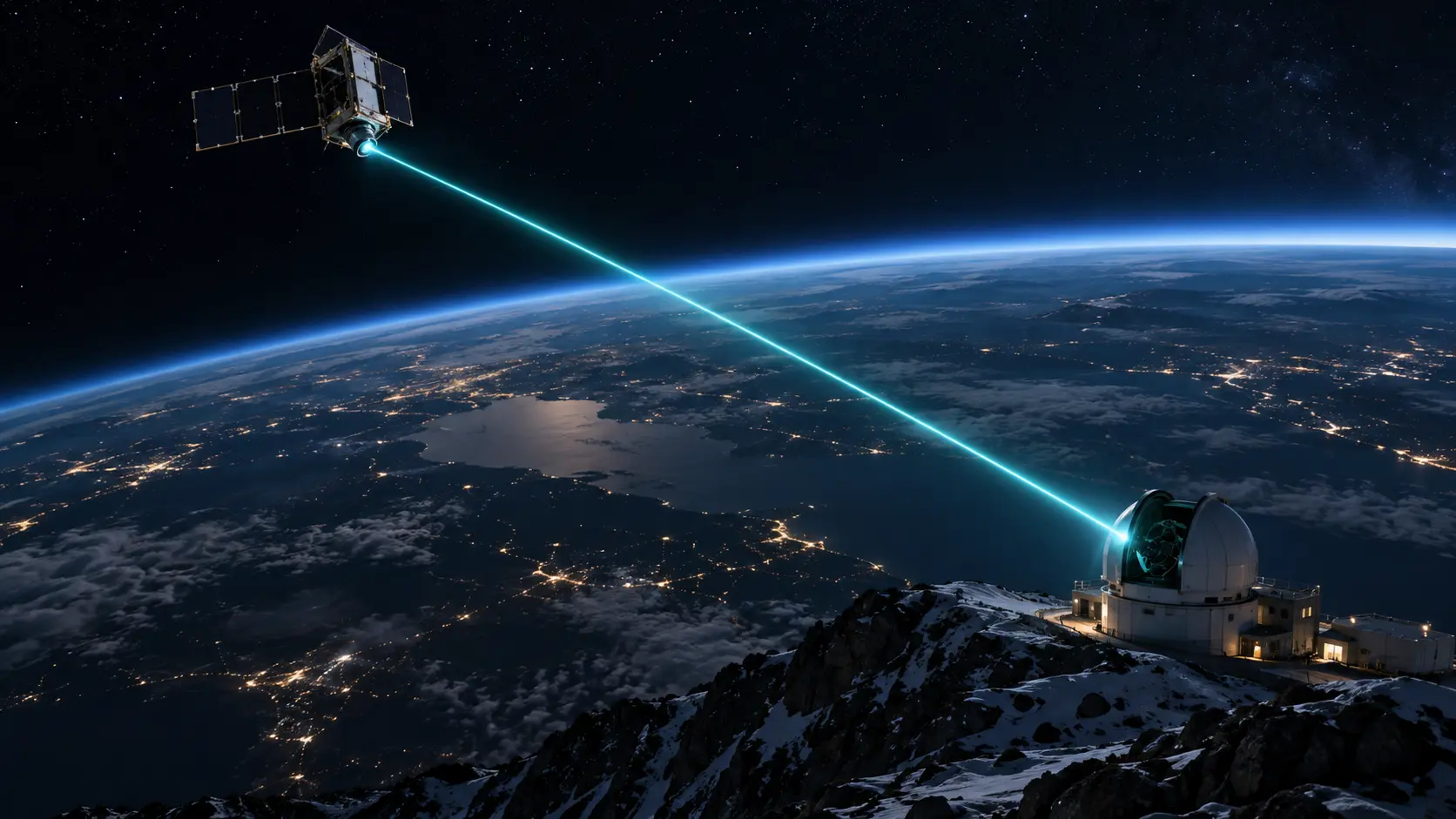
The Terabyte Infrared Delivery experiment demonstrated a 200 Gbit/s optical downlink, reported as the fastest space-to-ground laser link at the time.
- Team / system
- NASA SCaN · MIT Lincoln Laboratory · PTD-3
- Link geometry
- Low Earth orbit to ground
- Platform
- TBIRD payload on PTD-3
- Year / programme
- 2023
01 · SYSTEM
How it was achieved
TBIRD combined commercial fiber-optic components with a compact optical terminal and a reliability strategy designed for atmospheric fades. Data blocks that were not received correctly could be retransmitted, allowing very high burst rates without pretending the atmosphere was a perfect channel.
02 · EVIDENCE
Evidence snapshot
- 01
200 Gbit/s demonstrated on the space-to-ground optical link.
- 02
Hosted on the PTD-3 spacecraft with the TBIRD payload developed by MIT Lincoln Laboratory.
- 03
The same programme had previously transferred 1.4 terabytes in less than five minutes.
03 · SIGNIFICANCE
Why it matters
The result shows that small spacecraft can support optical downlinks approaching terrestrial backbone rates when the terminal, ground receiver and data-recovery protocol are engineered together.
05 · REFERENCES
Sources & references
The values in this file are traced to the sources below. Record language follows the wording supported by the primary evidence.
Discuss a related technical problem
Related research by Meysam Ghanbari
Research collaboration, industrial R&D and technical discussions concerning optical and satellite links can be directed through the professional contact pathway.