Abstract
Original text · supplied manuscript
Free-space quantum key distribution (FS-QKD) enables secure key exchange without fixed infrastructure, but its practical deployment is severely limited by line-of-sight blockage and sensitivity to geometric and atmospheric impairments. This paper investigates an optical intelligent reflecting surface (IRS)assisted quantum communication architecture that establishes an effective indirect path when the direct link is unavailable. An end-to-end channel model is developed for the cascaded transmitter-IRS-receiver link, jointly accounting for geometric coupling losses, IRS phase control, pointing and alignment errors, atmospheric attenuation, and turbulence. The derived model is directly linked to quantum performance metrics, enabling tractable evaluation of the quantum bit error rate and secret key rate. Numerical results demonstrate that IRS-assisted links can substantially enhance robustness against misalignment and reveal an optimal beam-radius configuration that balances geometric loss and pointing-error resilience. The proposed framework provides design-level insight for reliable IRS-assisted FS-QKD under practical channel conditions.
ENGINEERING QUESTION
How can an optical reflecting surface support free-space QKD when the direct line of sight is blocked?
The paper models a two-hop transmitter–IRS–receiver path and links photon collection, reflection errors and receiver field of view to QBER and an asymptotic decoy-state BB84 secret-key-rate calculation. Joint beam-radius selection balances pointing tolerance against aperture spillage under the evaluated geometry.
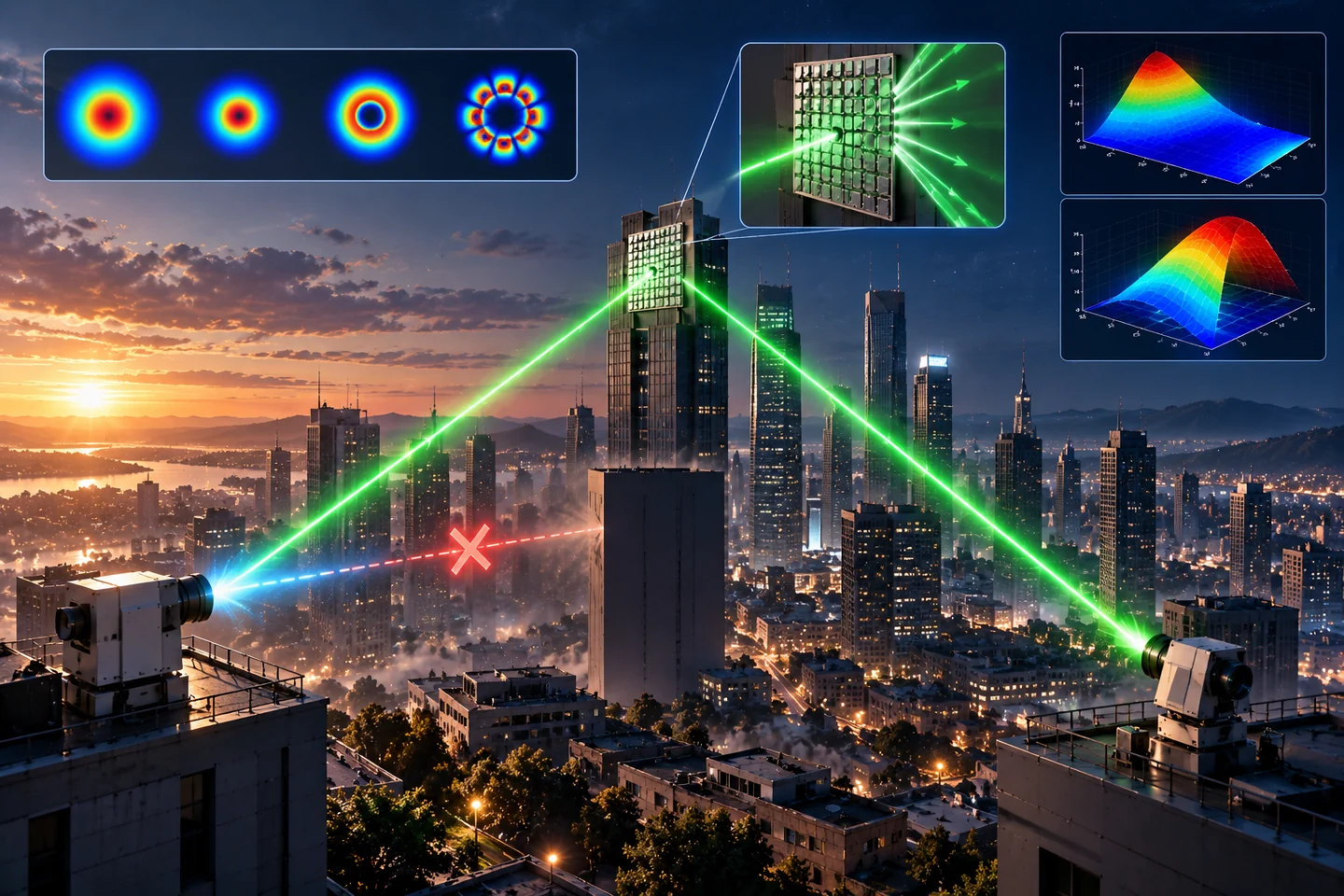
Architecture and channel assumptions
A ground transmitter emits polarization-encoded weak coherent pulses. An optical intelligent reflecting surface redirects them toward a ground receiver when the direct path is blocked. Its tilted circular aperture appears elliptical to the incident beam, which changes photon capture.
The model includes Gaussian-beam geometry, transmitter pointing error, IRS reflection-angle error, Beer–Lambert attenuation, independent normalized Gamma–Gamma turbulence on two hops, and receiver angle-of-arrival fluctuations. A lens, single-mode fiber and narrow spectral filter feed polarization analysis and single-photon avalanche diodes. The fiber geometry sets the acceptance field of view.
IRS-induced polarization transformations are assumed deterministic and compensated. The passive scalar reflection coefficient and independent random impairments are modeling assumptions.
Manuscript · Section II; Fig. 1; Eqs. (1)–(27)
Analysis and numerical validation
Conditional single-photon detection probability combines capture at the IRS, reflection efficiency, receiver coupling and field-of-view acceptance. Aperture and pointing grids approximate coupling integrals efficiently for parameter sweeps. Under the independence and unit-mean turbulence assumptions, mean transmittance factorizes.
The averaged channel feeds gain and QBER expressions and an asymptotic decoy-state BB84 secret-key-rate calculation. Numerical examples use 1550 nm pulses at 1 GHz, mean photon number 0.1, two 1 km hops, IRS radius 10 cm, receiver lens radius 5 cm and detector efficiency 0.8.
Manuscript · Section III; Eqs. (28)–(43); Section IV
Results and engineering interpretation
Beam radii that are too narrow are sensitive to pointing displacement; overly broad beams spill power beyond the finite apertures. The manuscript therefore reports an interior optimum for the pair of beam radii at the IRS and receiver, rather than a rule to maximize beam width.
The numerical comparison uses pointing-error standard deviations of 200 and 400 µrad. Greater misalignment shifts the favorable beam-size region toward wider beams and reduces the modeled secret key rate. Both hops must be considered together because improving one coupling term cannot undo loss in the other.
Manuscript · Section IV; Figs. 2–3
Scope and limitations
This is channel analysis and numerical simulation, not a demonstrated urban QKD network. Polarization compensation, independent impairments, a passive scalar IRS and average-transmittance evaluation constrain the interpretation. The asymptotic key-rate model does not establish a complete finite-key implementation or security against every practical side channel.
Several numerical beam-radius and key-rate values in the manuscript’s prose differ from its figure annotations. The editorial explanation therefore reports the supported trade-off without promoting a universal radius or an absolute demonstrated key rate.
Manuscript · Sections II–V
Publication record
- Authors
- Given Hamda Al-Maadeed, Nadeen Abunada, Rula Ammuri, Mohammad Taghi Dabiri, Meysam Ghanbari, Khalid Qaraqe
- Venue
- 2026 International Conference on Emerging Technologies and Engineering Systems (ICETES)
- Location
- Amman, Jordan
- Status
- Published
- Year
- 2026
- Publication date
- 2026-04-07
- Pages
- 477-483
- DOI
- 10.1109/ICETES68504.2026.11518890
The original abstract and technical explanation follow the supplied published manuscript. Authors, DOI and pagination are checked against the publisher’s record. The technical explanation is editorial and separate from the original abstract. Research note updated 2026-10-03.