Abstract
Original text · published article
Polarization-encoded satellite quantum key distribution (QKD) demands simultaneous, high-precision alignment of both spatial pointing and polarization reference frames. However, classical tracking systems ignore polarization, and existing QKD solutions treat it via slow, separate calibration, leaving a critical gap for real-time joint stabilization in dynamic inter-satellite links. This work introduces a novel dual-wavelength auxiliary system that, through a new artificial-angle diversity scheme, renders the transmitter tracking error observable after single-mode fiber coupling in a practical sense, thereby enabling joint estimation. We propose a family of estimators: a three-dimensional maximum-likelihood (3D-ML) benchmark, a new decoupled two-stage 2D-ML method, and a novel log-linear approximate ML (Log-Lin) estimator. The Log-Lin method decouples polarization estimation and solves the tracking error via a fast, deterministic weighted least-squares procedure, offering a closed-form solution. Furthermore, we provide a comprehensive design analysis that characterizes the critical trade-offs between tracking and polarization accuracy with respect to tunable parameters, most notably the artificial-angle radius. Extensive Monte Carlo simulations for a 1000-km inter-satellite link demonstrate that the Log-Lin estimator achieves micro-radian tracking and sub-degree polarization accuracy while completing in only 30µs, over two orders of magnitude faster than iterative searches. These results establish a practical pathway toward real-time joint stabilization of quantum satellite links.
ENGINEERING QUESTION
How can a satellite QKD terminal estimate transmitter pointing error and polarization rotation after single-mode fiber coupling removes spatial detail?
A strong auxiliary wavelength shares the quantum optical path. Controlled transmitter angular offsets make received auxiliary power vary across known states, while paired polarization measurements isolate reference-frame rotation. A log-linear estimator then trades a small accuracy penalty for much shorter reported processing time than iterative searches in the simulated inter-satellite case.
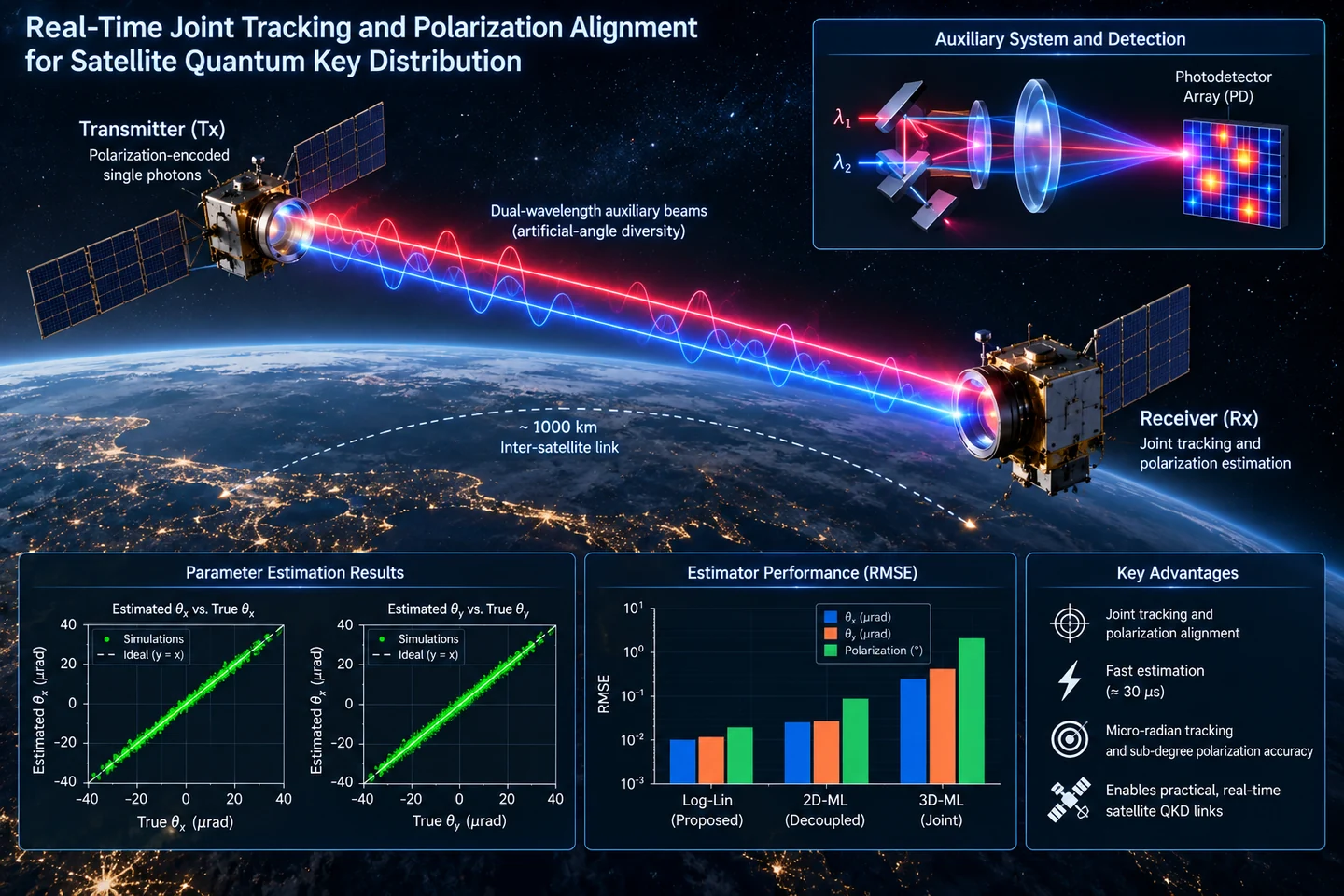
Shared optical path and complementary measurements
The quantum wavelength carries polarization-encoded signals; a stronger classical auxiliary wavelength provides enough power for tracking and polarization measurements. An AoA branch taps light before single-mode fiber coupling to address receiver orientation. After the fiber, wavelength separation sends quantum light to the QKD receiver and auxiliary light to a basis selector, polarization beam splitter and paired photodiodes.
The model distinguishes transmitter pointing deviation, receiver angular jitter and roll-induced polarization rotation. Gaussian pointing loss and a finite field of view determine collected auxiliary power. Atmospheric Gamma–Gamma fading is included for ground-to-LEO modeling, but the principal numerical study is a 1000 km inter-satellite path with turbulence neglected.
Manuscript · Section II; Fig. 1; Eqs. (1)–(18)
Artificial-angle diversity and estimator design
Each update includes a zero-offset state and known small auxiliary pointing offsets, each followed by four deterministic polarization subpulses. The offsets create state-dependent power measurements that reveal the transmitter tracking error otherwise hidden by symmetric single-mode coupling. Normalized differences between paired photodiode outputs cancel common power factors and approximately isolate polarization rotation at sufficiently high auxiliary SNR.
The paper develops joint 3D maximum likelihood, decoupled 2D maximum likelihood and a log-linear approximate method. The latter uses logarithmic power ratios and weighted least squares for the two tracking components. Its derivation assumes small angles and channel conditions that are approximately constant during the update. It is an approximation with an accuracy–latency trade-off.
Manuscript · Section III; Propositions 1–2; Algorithms 1–2
Validation setup and the accuracy–latency trade-off
The baseline uses a 45 m beam radius at the 1000 km receiver plane, 5 cm effective aperture radius, 15 µrad transmitter and receiver jitter, 30 dBm auxiliary transmit power, eight artificial-offset states and a 0.1 ms update interval. The tracking comparison uses 500,000 Monte Carlo trials. Comprehensive 2D-ML is compared with the expensive 3D-ML reference on 100 random samples, with reported average component deviations below 1%.
The article reports approximately 0.4 µrad tracking RMSE for comprehensive 2D-ML, 2.2 µrad for the limited search and 2.7 µrad for Log-Lin. Corresponding reported runtimes are about 4.5 ms, 1.0 ms and 0.03 ms per sample. Log-Lin is fastest, while the comprehensive search is most accurate. The limited search can produce a distinct population of outliers when the true error lies outside its search region.
Manuscript · Section IV; Tables II–III; Fig. 2
Design parameters and engineering meaning
Artificial-offset radius must provide enough spatial diversity without excessive pointing loss. The studied case identifies an approximately 8–16 µrad favorable range and selects the lower end to preserve polarization accuracy. This range is conditional on the baseline optics, noise and jitter; it is not a universal satellite-terminal setting.
Beam width similarly balances sensitivity against collected-power robustness. A longer measurement interval improves estimation SNR but may violate the quasi-static assumption and make corrections stale. The reported 30 µs is estimator execution time in the simulation environment, not the complete sensing, communication, actuator and feedback-loop latency.
Manuscript · Section IV; Figs. 3–5
Scope and limitations for a quantum terminal
The work establishes an analytical auxiliary architecture and simulation-based estimator comparison. It does not demonstrate an orbital terminal, a closed-loop hardware implementation or an experimentally measured secret-key-rate increase. The detailed quantum detection path, background noise and complete key-rate analysis are explicitly outside the paper’s main scope.
Implementation requires both wavelengths to remain single-mode in the common fiber, adequate isolation of the strong auxiliary signal from the quantum detector, synchronization of offset and polarization states, and a functioning receiver AoA subsystem. The high-SNR normalization and quasi-static log-linear approximation can lose accuracy outside their operating conditions. Improved alignment supports QKD, but does not replace protocol-specific security analysis.
Manuscript · Sections II-E, III and IV; footnotes 3–4; Section V
Publication record
- Authors
- Mohammad Taghi Dabiri, Meysam Ghanbari, Rula Ammuri, Mazen Hasna, Khalid A. Qaraqe
- Venue
- IEEE Transactions on Communications
- Status
- Published
- Year
- 2026
- Publication date
- 2026-06-24
- Volume
- 74
- Pages
- 11062-11075
- DOI
- 10.1109/TCOMM.2026.3706615
The original abstract, full author list, publication date and technical explanation follow the supplied published IEEE article. The DOI, volume and pagination are also verified against the publisher record. The technical explanation is editorial and separate from the original abstract. Research note updated 2026-10-03.