Abstract
Original text · supplied manuscript
In this paper, we investigate the performance of physical-layer security of a pinching-antenna system on a lossless dielectric waveguide. In particular, the system uses a single pinching-antenna to convey confidential information from a base station to a legitimate destination equipped with a single antenna, while an eavesdropper, also equipped with a single antenna, attempts to decode the transmitted information. As such, the performance of the pinching-antenna system is evaluated in terms of average secrecy capacity, strictly positive secrecy capacity, and secrecy outage probability. To this end, accurate mathematical expressions for the aforementioned performance metrics are provided. To validate the analysis, the analytical results are numerically evaluated and further validated through Monte-Carlo simulations. The results demonstrate that secrecy capacity between the base station and the legitimate destination improves when the height of the pinching-antenna placed closer to the destination. Additionally, the performance can be improved when the eavesdropper’s location over a rectangular area increases.
ENGINEERING QUESTION
How does the geometry of a pinching-antenna link affect its physical-layer secrecy against a passive eavesdropper?
The paper derives average secrecy capacity, the probability of positive secrecy capacity and secrecy outage for a single pinching antenna on a lossless dielectric waveguide. Numerical evaluation and Monte Carlo simulation connect antenna height and receiver-channel conditions to these metrics under the specified wiretap model.
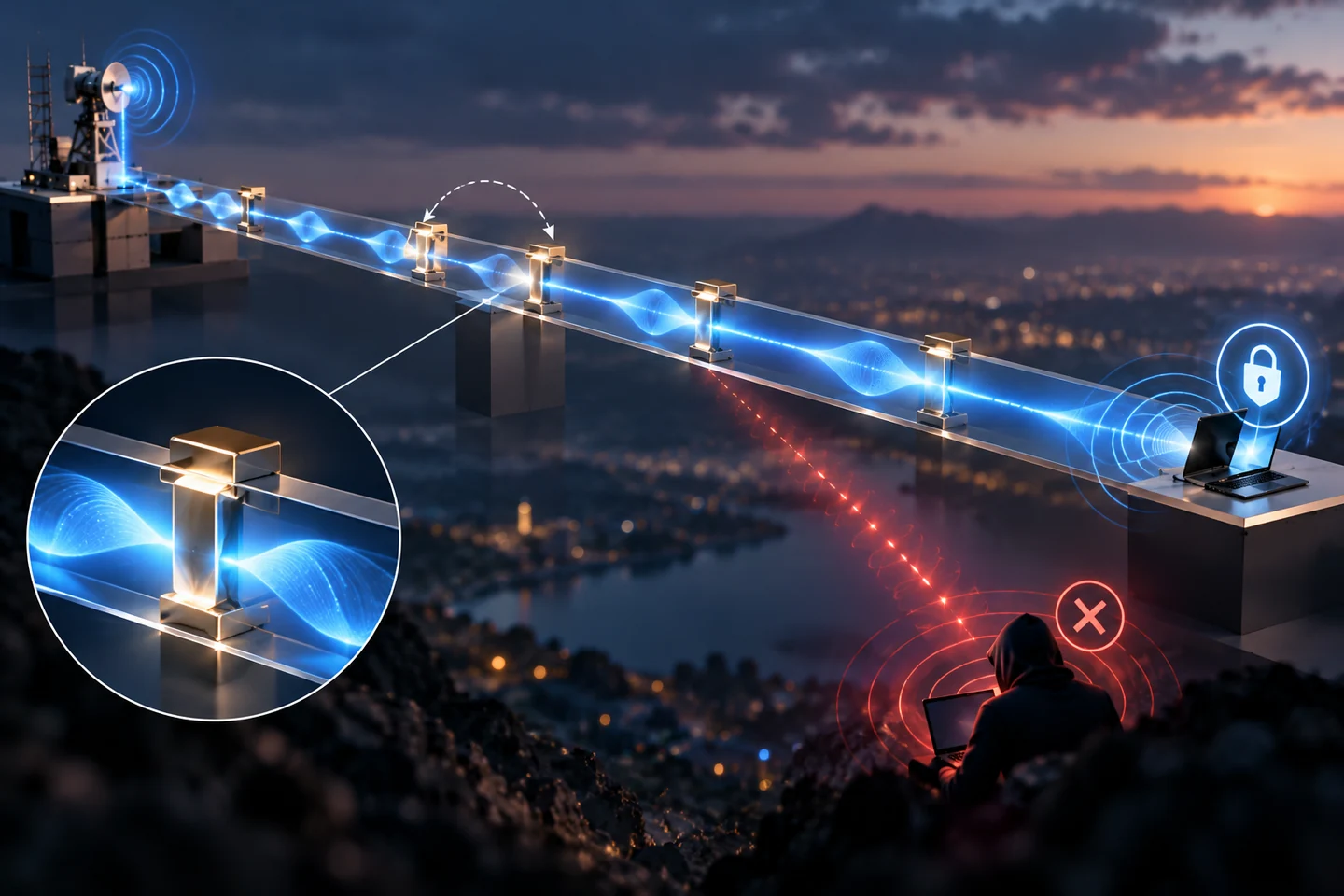
Architecture and channel assumptions
A base station feeds one pinching antenna on a dielectric waveguide parallel to the x-axis at height h. One single-antenna legitimate destination receives the message; a separate single-antenna eavesdropper attempts to decode it. Receiver locations are uniformly distributed within rectangular areas.
The model assumes a lossless waveguide, line-of-sight free-space propagation, independent legitimate and eavesdropper channel variables, and additive white Gaussian noise. The tractable SNR distributions are adopted from a prior single-user pinching-antenna result.
Manuscript · Section II; Fig. 1; Eqs. (1)–(6)
Secrecy metrics and validation
Instantaneous secrecy capacity is the positive part of the difference between the legitimate and eavesdropper channel capacities. The paper integrates the SNR distributions to obtain average secrecy capacity and the probability that secrecy capacity is strictly positive.
The average-capacity discussion assumes eavesdropper channel knowledge at the transmitter. The secrecy-outage discussion treats the passive case without that knowledge and evaluates falling below a target secrecy rate. Numerical curves are compared with Monte Carlo simulations at 28 GHz, using the specified geometry and −90 dBm noise power.
Manuscript · Section III; Eqs. (7)–(19); Section IV
Results and engineering interpretation
For Figure 2 with the eavesdropper average SNR fixed at 50 dB, reducing waveguide height from 6 m to 2 m increases modeled average secrecy capacity from about 1.5 to 3 bits/s/Hz at legitimate average SNR 80 dB. These are parameterized simulation results, not a measured secure data rate.
Increasing legitimate-channel SNR or reducing eavesdropper-channel SNR improves the evaluated secrecy metrics. Under identical channel and region parameters, the manuscript reports probability 0.5 of positive secrecy capacity.
Manuscript · Section IV; Figs. 2–5
Scope and limitations
The lossless single-antenna model does not demonstrate a secure installed network, cryptographic protection or resistance to every adversary. Waveguide loss, multiple pinching antennas, channel correlation and practical eavesdropper estimation require separate treatment.
The supplied manuscript gives inconsistent statements about the direction of the eavesdropper-region-width effect between its Figure 4 discussion and conclusion. That trend is therefore not presented here as a general placement rule. The original abstract remains reproduced below its own heading without editorial correction.
Manuscript · Sections III–V
Publication record
- Authors
- Osamah S. Badarneh, Hugerles S. Silva, Meysam Ghanbari, Yazan H. Al-Badarneh, Tamer M. Khattab, Mazen O. Hasna, Khalid A. Qaraqe
- Venue
- 2026 6th Middle East and North Africa Communications Conference (MENACOMM)
- Location
- Hammamet, Tunisia
- Status
- Published
- Year
- 2026
- Pages
- 1-6
- DOI
- 10.1109/MENACOMM69507.2026.11532869
The abstract and technical explanation follow the supplied arXiv v2 manuscript (30 June 2026), titled “Secrecy Analysis of Pinching-Antenna Systems” inside the PDF. The published MENACOMM title and DOI are verified against the institutional and publisher records. The technical explanation is editorial and separate from the original abstract. Research note updated 2026-10-03.