Abstract
Original text · supplied manuscript
Orbital Angular Momentum (OAM)-based Free-Space Optical (FSO) communication systems offer immense potential for high-capacity, secure links, but their performance is highly sensitive to pointing errors. This paper provides a comprehensive analysis of OAM systems under pointing inaccuracies for both short-range terrestrial links and long-range inter-satellite communications. For short links, we demonstrate the trade-offs between increasing modulation order and the number of OAM modes, highlighting the potential of low-complexity two-stage detectors to mitigate computational overhead while maintaining robust performance. For inter-satellite links, where severe pointing errors dominate, we propose an innovative asymmetric mode design and optimal beam waist adjustment to enhance robustness against angular misalignments. Simulation results reveal critical insights into the interplay between pointing error intensity, mode selection, and system performance, offering practical guidelines for OAM system design in diverse scenarios. This work bridges the gap between theoretical modeling and real-world implementation, paving the way for reliable OAM-based communication in next-generation terrestrial and space networks.
ENGINEERING QUESTION
How can an OAM optical link preserve data recovery when pointing errors destroy mode orthogonality?
The paper computes misalignment-dependent coupling between Laguerre–Gaussian modes rather than treating pointing error as scalar power loss alone. It uses a two-stage detector for small-error short links, and asymmetric mode groups with beam-size selection for the simulated long inter-satellite case.
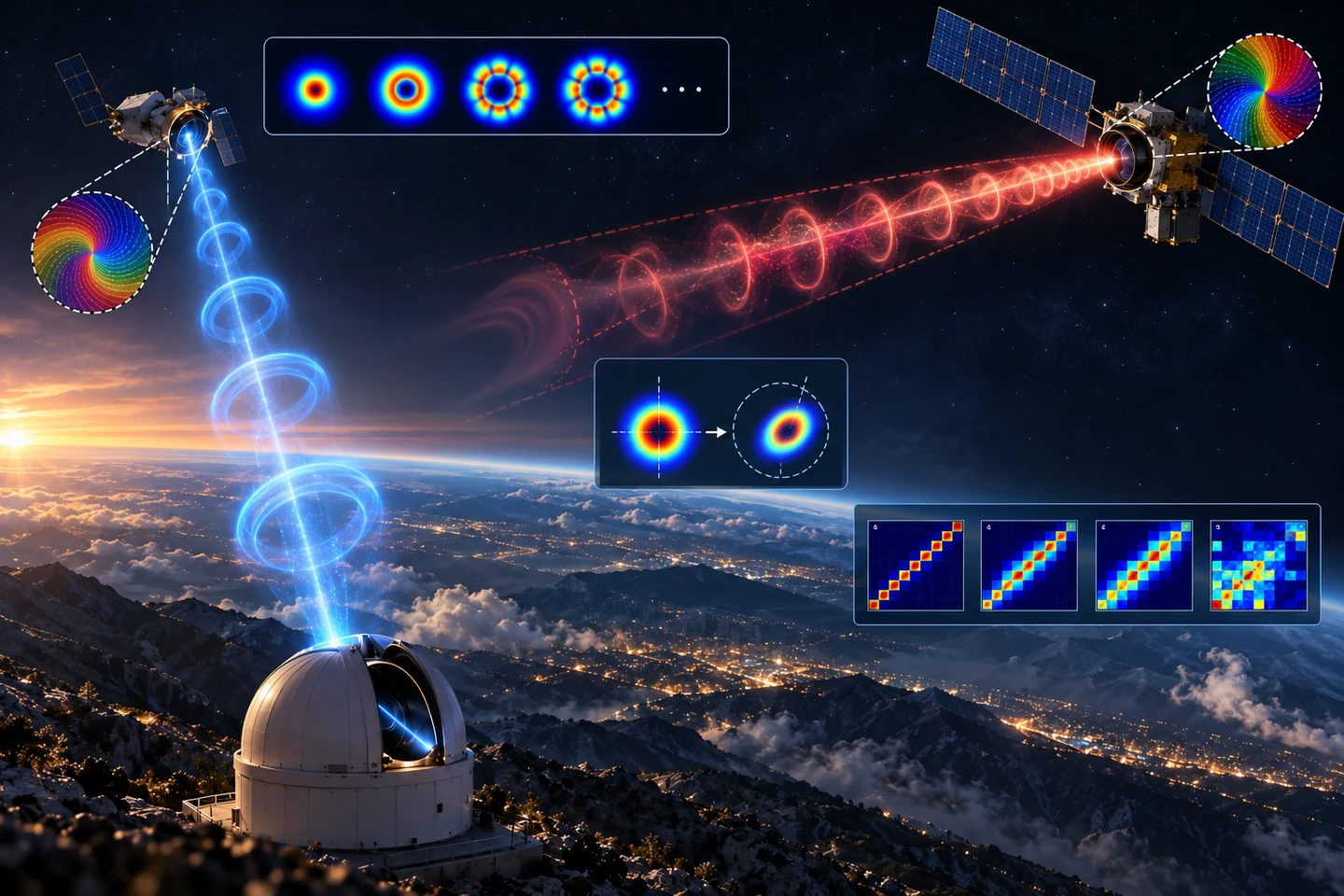
Architecture and channel assumptions
Multiple Laguerre–Gaussian modes carry intensity-modulated M-PAM data on one optical path. A finite receiver aperture and phase-based mode separation feed avalanche photodiodes. The noise model includes received-power-dependent shot noise and thermal noise.
The study isolates pointing error: turbulence is neglected for the assumed short clear-air links and is absent in the vacuum inter-satellite model. Zero-mean Gaussian transverse displacement shifts the beam relative to the aperture; overlap integrals determine a crosstalk matrix between transmitted and detected modes.
Manuscript · Sections II–III; Eqs. (1)–(23)
Detection and design method
Joint maximum-likelihood detection searches Mᴸ symbol combinations for L modes. When pointing errors are small and the coupling matrix is nearly diagonal, individual-mode detection followed by interference refinement reduces the two-stage search to approximately 2ML metric evaluations. This detector relies on the low-crosstalk regime.
For the long-link example, symmetric positive and negative mode groups can produce nearly indistinguishable received coefficients. An asymmetric transmitted set, such as {−5, −3, −1, 0, 2, 4}, separates the two grouped channels. Beam-size sweeps examine the trade-off between received power and tolerating angular error. Pilot-based channel estimation is discussed, with a corresponding overhead trade-off.
Manuscript · Section IV; Eqs. (24)–(34); Fig. 6
Simulation findings and engineering interpretation
The manuscript evaluates 100 m terrestrial and 1000 km inter-satellite links at 1550 nm. The short-link comparison keeps total transmitted power at 100 mW while changing mode count and modulation order. In its low-error regime, adding modes can be less damaging to BER than increasing modulation order.
Wider mode spacing helps the two-stage detector in the studied conditions, while its benefit is not automatic for joint ML detection because received power also changes. On a 1000 km link, 10 µrad angular error corresponds geometrically to about 10 m displacement. Asymmetric mode grouping and beam-size selection must therefore be evaluated separately from millimeter-error short-link detection.
Manuscript · Table I; Section V; Figs. 7–13
Scope and limitations
This is theoretical modeling and simulation, not an orbital demonstration or a measured high-capacity link. Conclusions depend on selected mode sets, aperture size, beam parameters, pointing statistics and channel estimation. The work does not prove unlimited OAM capacity, general immunity to turbulence or a cryptographic security guarantee. The decorative intensity maps in the concept image are not the manuscript’s numerical plots.
Manuscript · Sections II–VI
Publication record
- Authors
- Mohammad Taghi Dabiri, Meysam Ghanbari, Mazen Hasna
- Venue
- IEEE Photonics Journal
- Status
- Published
- Year
- 2025
- Publication date
- 2025-08
- Volume
- 17
- Issue
- 4
- Pages
- 1-14
- DOI
- 10.1109/JPHOT.2025.3575365
The original abstract and technical explanation follow the supplied manuscript. Bibliographic details are checked against the publisher’s Crossref record. The technical explanation is editorial and separate from the original abstract. Research note updated 2026-10-03.