Abstract
Original text · supplied manuscript
This paper addresses the design of a free-space optical (FSO) link between an unmanned aerial vehicle (UAV) and a high-altitude platform (HAP) in the practical scenario of generalized pointing errors (PE) and beam wandering (BWAN). We particularly focus on the outage probability associated to the UAV-to-HAP link, as performance measure. More precisely, we propose to select appropriately the system parameters such as optical beamwidth used at the UAV and its flight altitude so as to minimize the outage probability. First, we characterize the channel statistics by taking into account the joint influence of attenuation loss, atmospheric turbulence and generalized pointing inaccuracies particularly impaired by BWAN. Second, we use the developed channel expression to formulate the closed-form expressions for outage probability, where we also derive an asymptotic expression at high signal-to-noise ratios (SNR)s, which can be used over a wide range of SNRs. Third, we use the derived asymptotic outage expression to formulate an optimization problem which is then solved to derive the optimum beamwidth at the UAV leading to the instantaneous minimum outage probability under generalized PE and BWAN. We also derive a closed-form expression for the limit of optimum beamwidth under strong PE condition. Fourth, we address the practical scenario of beamwidth optimization for minimizing the average outage probability over diverse pointing and turbulence circumstances that a UAV might potentially encounter throughout its operational trajectory. Finally, we address the optimal UAV altitude to avoid strong turbulence so as to ensure efficient data transmission. Our simulation results validate both the effectiveness and the accuracy of the derived asymptotic outage probability and the adequate choice of beamwidth and flight altitude to minimize the average outage performance. For instance, our results show that at an SNR of 20 dBm, the link availability is increased from 20 % (with nominal beamwidth) to more than 70 % by adopting the proposed beamwidth optimization.
ENGINEERING QUESTION
Can beamwidth and UAV flight altitude reduce outage on a UAV-to-HAP optical uplink without relying only on more transmit power?
The paper combines attenuation, weak atmospheric turbulence, nonzero-boresight pointing error and beam wandering in an outage model. A high-SNR approximation yields a Lambert W-based optimal beamwidth. Altitude sweeps and fixed versus adaptive beamwidth designs identify conditional improvements in modeled link availability.
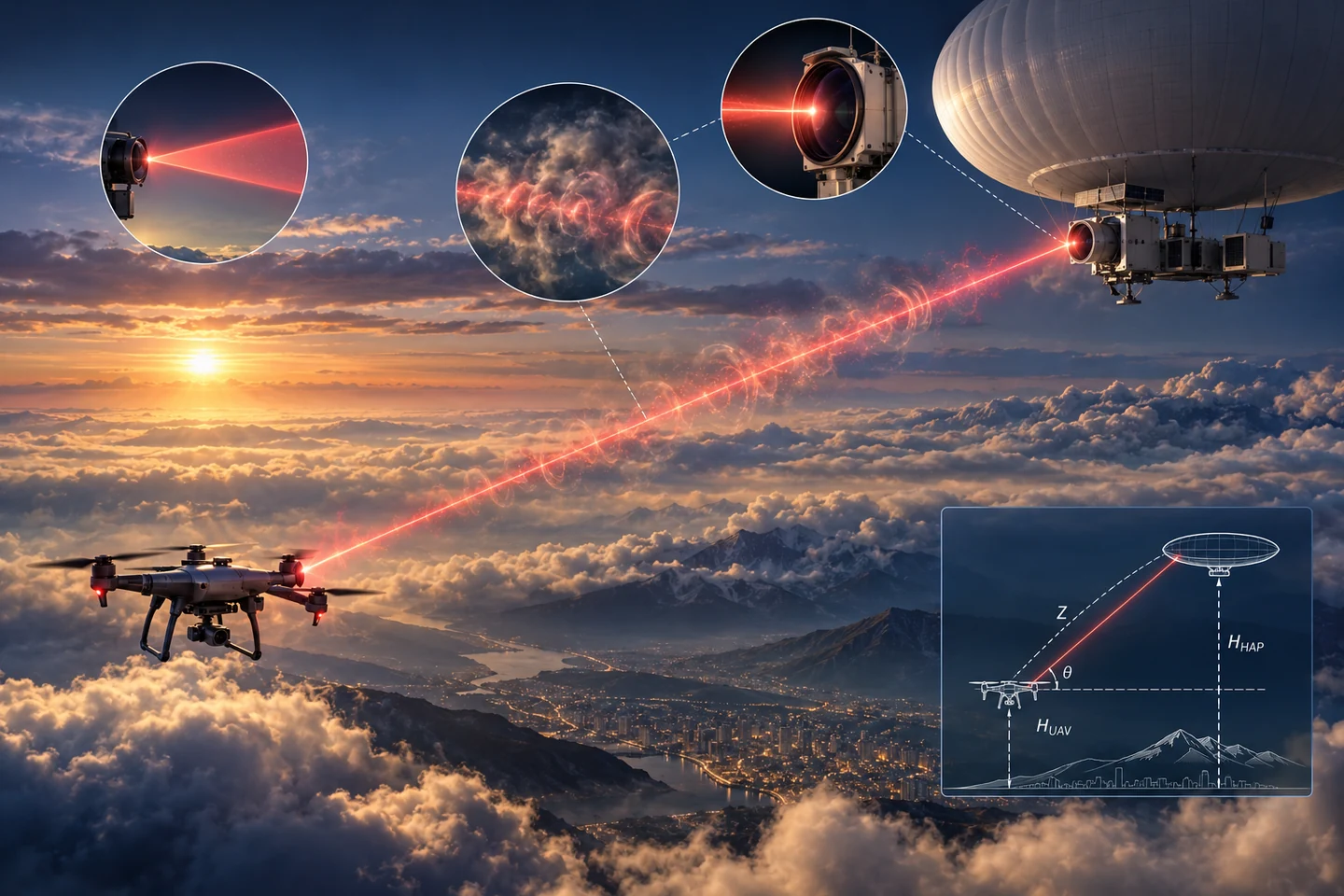
Architecture and channel assumptions
A hovering UAV sends an IM/DD on–off-keyed optical uplink to a hovering high-altitude platform. The modeled HAP altitude is 19–22 km. Transmitter and receiver locations are known; transverse position fluctuations are modeled, while small longitudinal fluctuations are neglected.
Channel gain is the product of deterministic Beer–Lambert attenuation, weak lognormal turbulence and pointing loss. Mechanical jitter may have nonzero means and unequal axis variances. Beam-wander displacement is added to mechanical displacement; an approximation to the resulting Beckmann distribution makes the model tractable. Turbulence fading and pointing loss are treated as independent.
Manuscript · Sections II–III; Eqs. (5)–(25)
Optimization and validation
The exact outage expression is accompanied by a high-SNR approximation. Minimizing the latter produces a closed-form optimum involving the Lambert W-function, using a small-aperture approximation. A limiting beamwidth is also derived for strong pointing error.
The practical comparison assumes known probabilities of several pointing and beam-wander conditions. Adaptive design changes beamwidth for each condition; the less complex fixed strategy selects one optimized beamwidth for the complete mixture. Simulation and numerical minimization check the analytical expressions.
Manuscript · Sections IV–VI; Eqs. (34), (43), (47), (49)–(50)
Results and engineering interpretation
For the two turbulence profiles and zenith-angle sweeps in the manuscript, most turbulence reduction occurs below roughly 400 m UAV altitude; the 400–600 m region shows diminishing returns. This is a result of the adopted altitude profile, not a universal flight-altitude prescription.
Analytical and numerically optimized beamwidths agree more closely in the evaluated higher-SNR regime. At stronger pointing error the optimum tends toward the derived upper limit. Fixed and adaptive optimization give similar average availability in the selected mixture, making a fixed design a useful complexity trade-off.
Manuscript · Section VI; Figs. 3–9
Scope and limitations
The evidence consists of channel analysis and simulations, not an airborne optical demonstration. Weak turbulence, approximated pointing statistics, known condition probabilities and the asymptotic optimization restrict the result. The supplied manuscript labels some normalized SNR axes in dBm; those labels are preserved in its abstract, but are not reinterpreted here as a universal calibrated SNR specification.
Manuscript · Sections III–VI
Publication record
- Authors
- Meysam Ghanbari, Mahdi Ataee, Seyed Mohammad Sajad Sadough
- Venue
- Optik
- Status
- Published
- Year
- 2024
- Publication date
- 2024-09
- Volume
- 312
- Pages
- 171953
- Article number
- 171953
- DOI
- 10.1016/j.ijleo.2024.171953
The original abstract and technical explanation follow the supplied manuscript. Bibliographic details are checked against the publisher’s Crossref record. The technical explanation is editorial and separate from the original abstract. Research note updated 2026-10-03.