Abstract
Original text · supplied manuscript
Accurate characterization of free-space optical (FSO) channels requires joint estimation of transmitter pointing errors, receiver angle-of-arrival (AoA) fluctuations, and turbulence-induced fading. However, existing literature addresses these impairments in isolation, since their multiplicative coupling in the received signal severely limits conventional estimators and prevents simultaneous recovery. In this paper, we introduce a novel multi-aperture FSO receiver architecture that leverages spatial diversity across a lens array to decouple these intertwined effects. Building on this hardware design, we propose a hierarchical deep learning framework that sequentially estimates AoA, transmitter pointing error, and turbulence coefficients. This decomposition significantly reduces learning complexity and enables robust inference even under strong atmospheric fading. Simulation results demonstrate that the proposed method achieves near-MAP accuracy with orders-of-magnitude lower computational cost, and substantially outperforms end-to-end learning baselines in terms of estimation accuracy and generalization. To the best of our knowledge, this is the first work to demonstrate practical joint estimation of these three key parameters, paving the way for reliable, turbulence-resilient multi-aperture FSO systems.
ENGINEERING QUESTION
Can a lens-array FSO receiver distinguish transmitter pointing error, receiver angular jitter and turbulence from the same measurements?
The paper separates the estimation into stages: normalized quadrant signals reveal angle of arrival, compensated lens aggregates estimate transmitter pointing error, and subtraction and gain removal recover receiver jitter and per-lens turbulence. Simulations show that the advantage depends on the parameter being estimated and the number of receiver lenses.
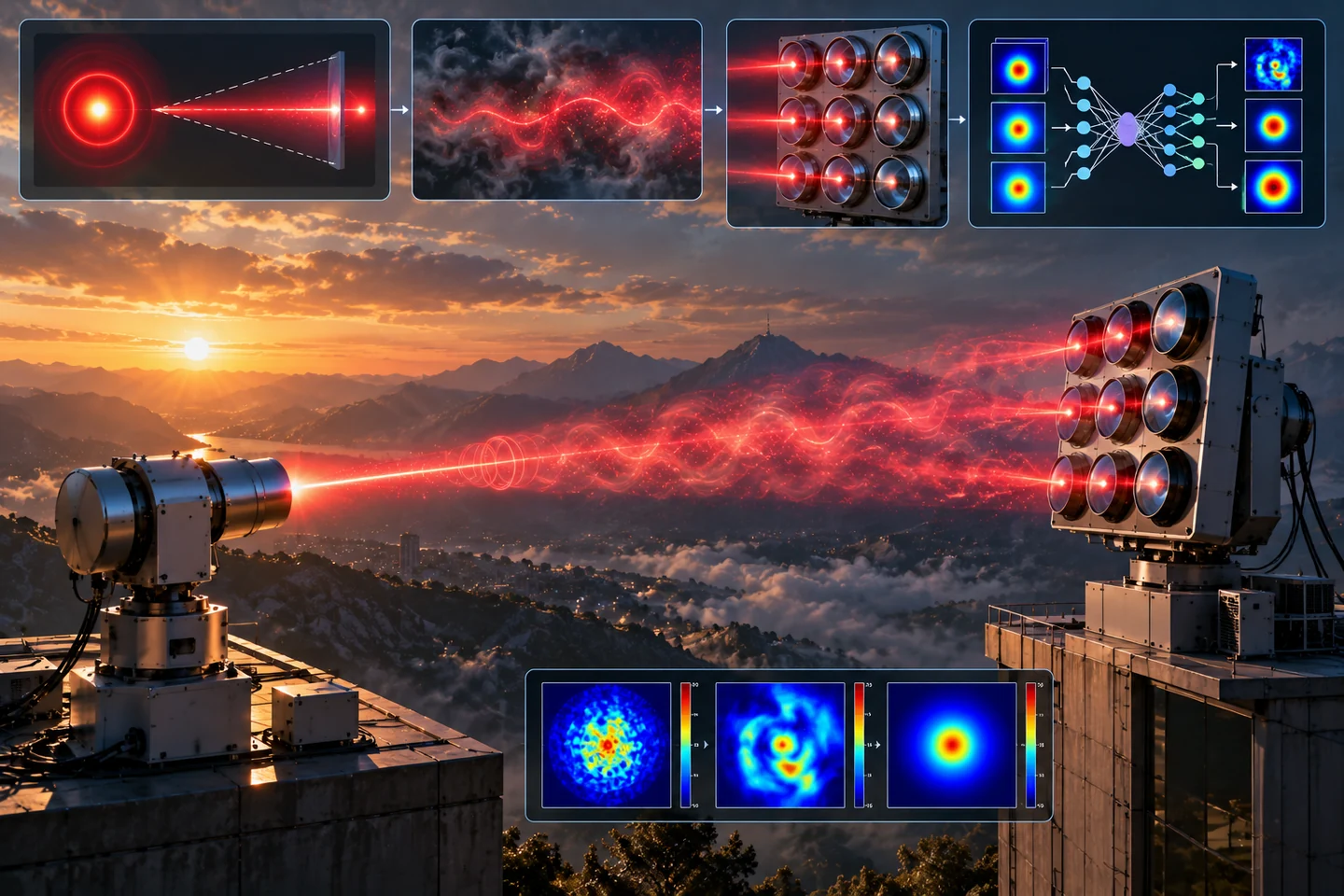
Receiver architecture and channel assumptions
An array of small lenses replaces one large collection optic. Each lens focuses onto its own quad photodetector, giving four spatial measurements per aperture. Transmitter angular error displaces the Gaussian beam on the lens plane; combined transmitter error and independent receiver jitter displace focal spots across the quadrant cells.
The model uses a beam much wider than an individual lens, a Gaussian approximation to the focal point-spread function, independent per-aperture Gamma–Gamma fades and additive Gaussian detector noise. Each measured current is the product of pointing gain, angle-of-arrival gain and turbulence, plus noise.
Manuscript · Section II; Fig. 1; Eqs. (1)–(18)
Hierarchical inference and validation
Stage 1 normalizes each lens’s four quadrant outputs to suppress common multiplicative gain and estimates angle of arrival with an MLP. It then aggregates the quadrant currents and removes estimated angular gain. Stage 2 estimates transmitter pointing error from the compensated lens signals. Stage 3 subtracts the angular estimates for receiver jitter and divides out pointing gain to estimate turbulence.
The supplied manuscript generates two million channel realizations per setup, divided equally between training and testing. It compares hierarchical learning, a larger end-to-end MLP and an exhaustive MAP reference. The default model uses a 500 m link, 1550 nm wavelength, 2 cm lens radius and 4, 16 or 64 lenses. Block averaging assumes that the impairments remain constant over 1000 samples.
Manuscript · Sections III–IV; Eqs. (19)–(36)
Results and engineering interpretation
Table II reports lower angle-of-arrival NMSE for hierarchical learning at each tested array size. With 16 lenses, x-axis AoA NMSE is 0.0010 for hierarchical learning versus 0.0025 for the end-to-end baseline. This is a parameter-specific simulation comparison, not universal superiority across all estimates.
The end-to-end model gives somewhat better transmitter-pointing estimates in the reported comparisons. More lenses improve the spatial evidence available to both methods. Turbulence recovery is especially sensitive to pointing-estimation errors: with only four lenses, the hierarchical turbulence NMSE becomes extremely large because dividing by an incorrectly estimated small pointing gain amplifies error. Sixteen and 64 lenses produce far more reliable estimates under the modeled conditions.
Manuscript · Section IV; Tables I–II
Scope and limitations
The evidence is simulation using a physics-based data generator, not a built receiver or field experiment. Independent fades, the wide-beam approximation, Gaussian focal spots and quasi-static blocks limit transfer to real hardware. Stage errors propagate through compensation and division; small estimated gains can destabilize turbulence recovery.
The manuscript’s near-MAP statement is supported by selected sample comparisons. Its large-scale NMSE table compares the two learning methods because exhaustive MAP evaluation is impractical at that scale. The paper does not establish a measured hardware inference latency or universal generalization outside the generated channel conditions.
Manuscript · Sections II–IV; Tables I–II
Publication record
- Authors
- Mohammad Taghi Dabiri, Meysam Ghanbari, Rula Ammuri, Mazen Hasna, Khalid Qaraqe
- Venue
- 2026 IEEE Wireless Communications and Networking Conference (WCNC)
- Location
- Kuala Lumpur, Malaysia
- Status
- Published
- Year
- 2026
- Publication date
- 2026-04
- Pages
- 1-6
- DOI
- 10.1109/WCNC65185.2026.11555383
The original abstract, author spelling and technical explanation follow the supplied arXiv v1 manuscript (13 December 2025). The published WCNC 2026 DOI and pagination are verified separately against the publisher record. The technical explanation is editorial and separate from the original abstract. Research note updated 2026-10-03.