Abstract
Original text · supplied manuscript
In this paper, we investigate the effect of meteorological conditions on the performance of a multiple-input single-output (MISO) free-space optical (FSO) communication system. First, by taking into account the effect of pointing error and turbulence, we derive an analytical channel model. Second, we derive a closed-form expression for the outage probability and the average link availability. We further analyze the complexity-performance trade-off and then we propose two beamwidth optimization methods to maximize the overall availability of the system in different weather conditions. We show that a significant performance improvement is achieved by using optimum adaptive beamwidth or by increasing the number of transmitters. The efficiency of the proposed method is validated through simulations using realistic meteorological data of Tehran, Iran.
ENGINEERING QUESTION
How should a MISO FSO link choose its beamwidth when weather changes turbulence and pointing loss?
The paper derives outage and weather-weighted link availability for several optical transmitters serving one receiver. It compares adaptive beamwidth with a fixed design, using Tehran weather data. A fixed optimized beamwidth approaches the adaptive design in the evaluated conditions while avoiding continuous beamwidth adjustment.
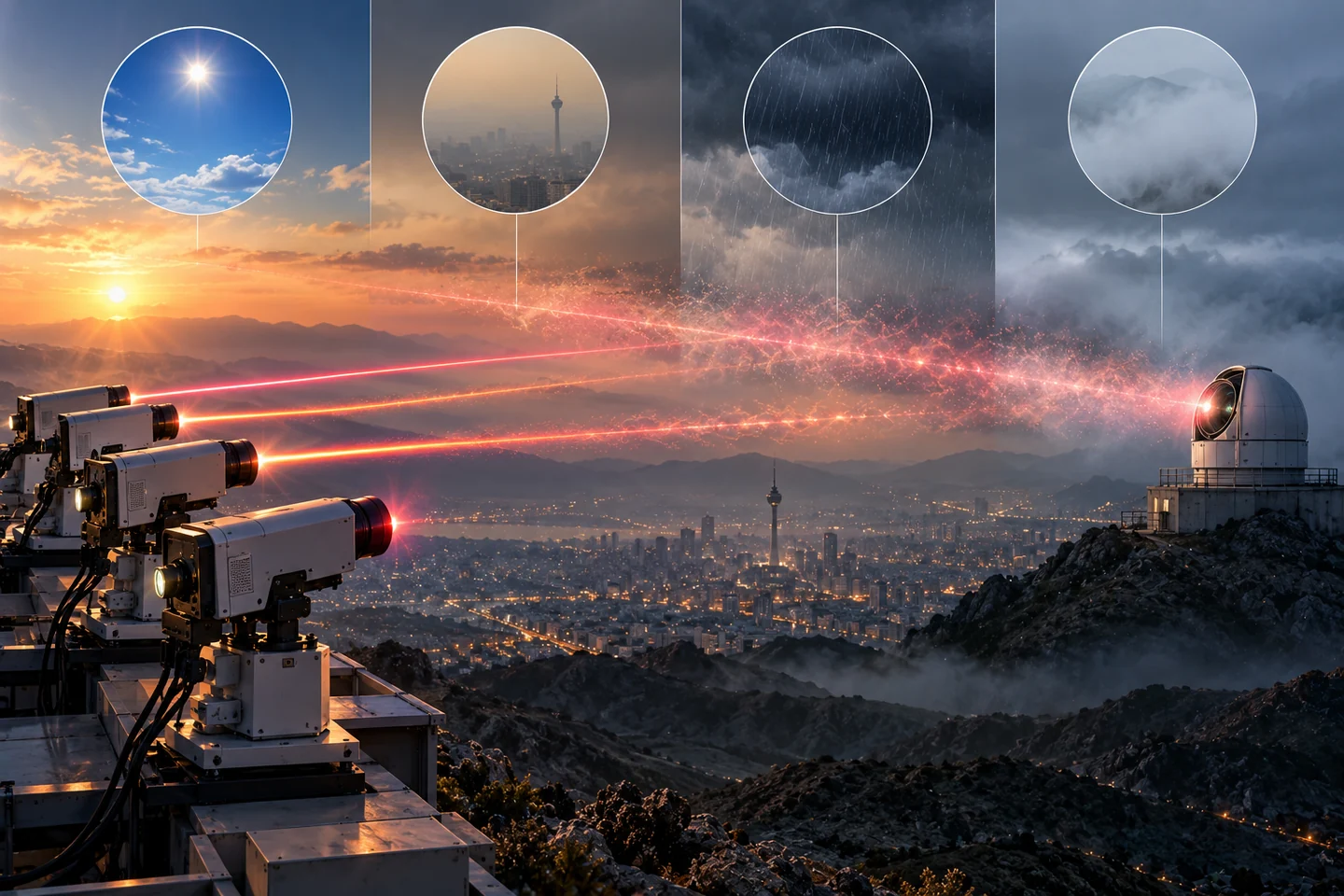
Architecture and channel assumptions
Multiple transmitters repeat an IM/DD on–off-keyed signal toward one receiver. Lognormal atmospheric gains model turbulence; temperature, relative humidity and wind speed enter a macro-meteorological refractive-index model. The transmitters move together, so their pointing displacements are correlated.
The analysis deliberately neglects attenuation to isolate turbulence and misalignment. Consequently, the weather illustration does not establish rain- or fog-limited link performance. A sum of lognormal terms is approximated by one lognormal variable to make the outage expression tractable.
Manuscript · Sections II–III; Eqs. (3), (8)–(11), (19)–(20)
Optimization and validation
A closed-form outage expression gives link availability as 100 × (1 − Pout). Availability is averaged over discrete weather conditions with their probabilities. Adaptive optimization selects a beamwidth for each condition; fixed optimization keeps one beamwidth and requires less transmitter adaptation.
Numerical evaluation uses realistic daily meteorological data for Tehran in February 2022. The configuration includes a 1 km link, 1550 nm wavelength and a 6 cm receiver radius. The manuscript discusses longer-term design, but the reported case study covers one month.
Manuscript · Sections IV–VI; Eqs. (26)–(30); Table I; Fig. 3
Results and the power comparison
In Figure 4, target outage 10⁻⁶ is reached at 29.7 dB for 4 × 1 MISO and 37 dB for SISO. The MISO case transmits total power M × P while SISO transmits P. This comparison therefore combines additional transmit power and spatial diversity; it does not establish an equal-total-power gain.
Fixed and adaptive beamwidth optimization perform closely for the evaluated transmitter counts. Beamwidth adaptation has the largest relative value where the unoptimized link is most constrained; increasing the transmitter count also increases system complexity.
Manuscript · Section VI; Figs. 4–5
Scope and limitations
This is model-based availability evaluated with weather data, not measured uptime from a deployed Tehran link. Neglected attenuation, lognormal approximations, correlated pointing and the month-specific data restrict generalization. The analysis does not establish performance in every climate or under equal total optical power.
Manuscript · Sections II–VII
Publication record
- Authors
- Meysam Ghanbari, Mahdis Saghaee Jahed, Seyed Mohammad Sajad Sadough
- Venue
- 2023 31st International Conference on Electrical Engineering (ICEE)
- Location
- Tehran, Iran
- Status
- Published
- Year
- 2023
- Publication date
- 2023-05-09
- Pages
- 479-483
- DOI
- 10.1109/ICEE59167.2023.10334716
The original abstract and technical explanation follow the supplied manuscript. Bibliographic details are checked against the publisher’s Crossref record. The technical explanation is editorial and separate from the original abstract. Research note updated 2026-10-03.