Abstract
Original text · supplied manuscript
In this paper, we investigate the outage performance of a mixed optical wireless communication (OWC) system consisting of an autonomous underwater vehicle (AUV) communicating with an unmanned aerial vehicle (UAV) via a buoying relay. More precisely, the considered setup uses an AUV that transmits a data stream to a decode-and-forward (DF) buoy relay using underwater optical wireless communication (UOWC). The buoy relay then stablishes a free space optical (FSO) link to send the data to the UAV final destination. Our model considers the effect of weak turbulence and pointing error for both UOWC and FSO links. We further analyze the importance of designing an optimal beam width in order to achieve the lowest outage probability of the total emitter-destination link. Numerical results are presented to confirm and support the accuracy of our derived analytical expressions.
ENGINEERING QUESTION
How can an underwater vehicle deliver data to a UAV when pointing errors and turbulence impair both optical hops?
The paper models an AUV-to-buoy underwater link followed by a buoy-to-UAV FSO link, combines their outage probabilities for decode-and-forward relaying, and studies beamwidth selection under weak turbulence. Reliability depends on both hops; atmospheric improvement alone cannot remove the underwater attenuation bottleneck.
Architecture and channel assumptions
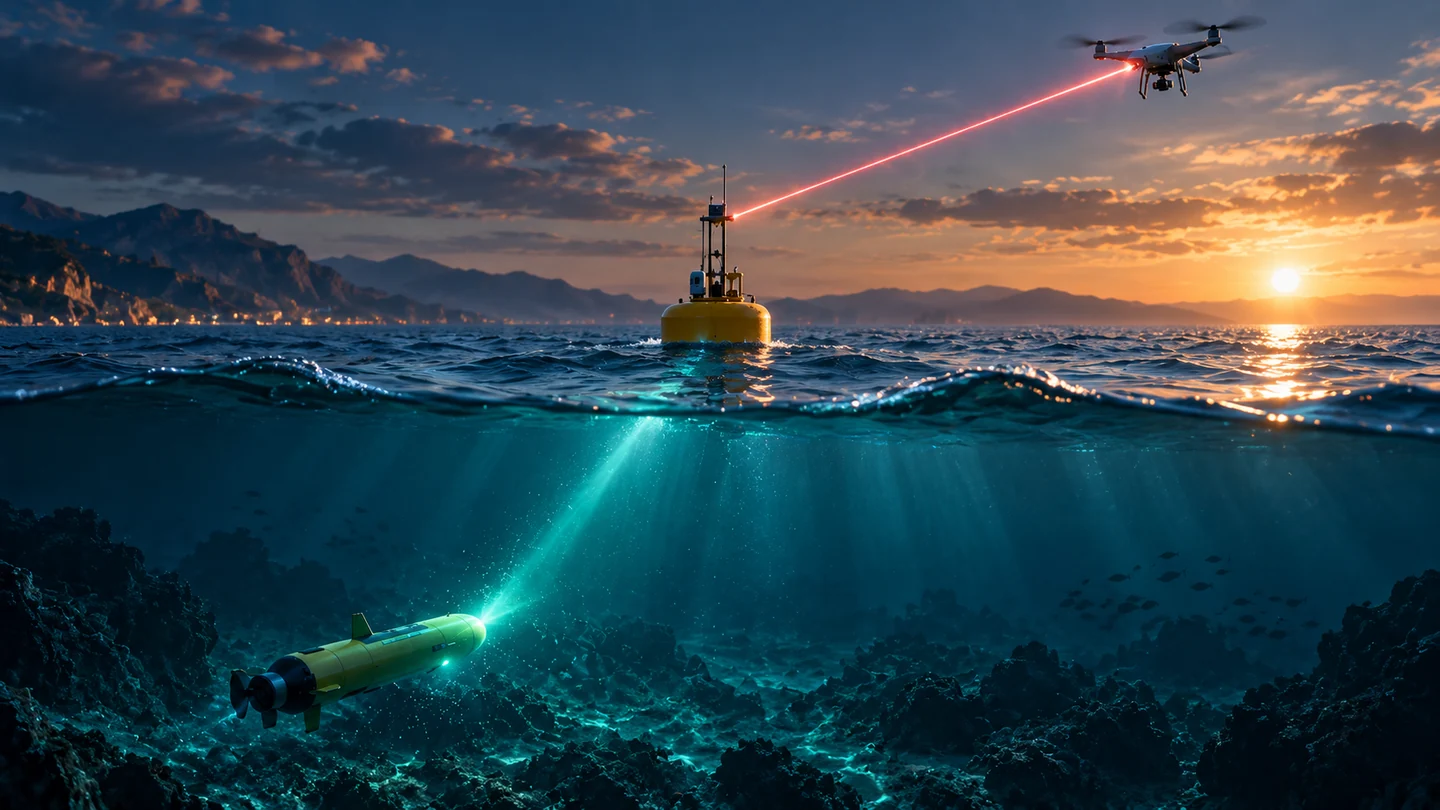
The autonomous underwater vehicle sends data to a surface buoy through underwater optical wireless communication. The buoy decodes and forwards that data to the UAV through free-space optical communication. Both hops use intensity modulation and direct detection with on–off keying.
The underwater and atmospheric channel gains include attenuation, weak lognormal turbulence and geometric pointing loss. Underwater attenuation follows the Beer–Lambert law. The end-to-end calculation treats the two hop outages as independent.
Manuscript · Sections II–III
Method and validation
Per-hop channel distributions lead to closed-form outage expressions. For independent hops, total outage is Pᵤw + Pₐ − PᵤwPₐ: failure of either hop interrupts the relay path. Beamwidth sweeps expose the compromise between collecting optical power and tolerating displacement.
Numerical and simulation comparisons examine clear-ocean and coastal water, underwater distances of 14–18 m and atmospheric distances of 1–1.2 km. The displayed configuration uses 532 nm underwater and 1550 nm in air, with a 20 cm receiver diameter.
Manuscript · Sections III–IV; Eq. (28); Table I
Results and engineering interpretation
Clear-ocean water gives lower outage than coastal water in the evaluated conditions. At higher transmitted power, underwater attenuation increasingly constrains the complete path.
The outage-minimizing beamwidth changes with available power. A wider beam can reduce pointing loss when sufficient power is available; a narrower beam concentrates power when attenuation dominates. The optima in the figures are examples for the selected parameters, rather than universal settings.
Manuscript · Section IV; Figs. 2–5
Scope and limitations
The evidence is analytical and numerical. The paper does not report an ocean deployment, flight test or demonstrated operational relay. Weak-turbulence models, independent hops, the selected water types and an ideal decode-and-forward relay bound the interpretation. Strong turbulence and vertically layered water require additional modeling.
Manuscript · Sections II–V
Publication record
- Authors
- Meysam Ghanbari, Mahdi Ataee, Seyed Mohammad Sajad Sadough
- Venue
- 2022 4th West Asian Symposium on Optical and Millimeter-wave Wireless Communications (WASOWC)
- Location
- Tabriz, Iran
- Status
- Published
- Year
- 2022
- Publication date
- 2022-05-12
- Pages
- 1-5
- DOI
- 10.1109/WASOWC54657.2022.9798419
The original abstract and technical explanation follow the supplied manuscript. Bibliographic details are checked against the publisher’s Crossref record. The technical explanation is editorial and separate from the original abstract. Research note updated 2026-10-03.