Abstract
Original text · supplied arXiv v1 manuscript (22 September 2026)
Joint information and energy transfer over inter-satellite free-space optical links is commonly based on explicit resource splitting, which couples communication reliability and energy delivery. This paper proposes a constant-total-power Stokes-orthogonal architecture that conveys information through polarization while preserving the received optical power for photovoltaic conversion. Complementary polarization branches support balanced information detection through their ac components, while their dc components drive matched multi-junction photonic power converters. The developed framework jointly characterizes pointing-impaired propagation, bit-error rate, outage, and nonlinear harvested power. The analysis establishes that the two information symbols only exchange the branch powers, leaving the unordered input-power pair unchanged; hence, the total harvested energy remains symbol invariant even under nonlinear conversion, without an explicit information–energy power split or linear-efficiency approximation. Numerical results confirm the analytical model, with the closed-form BER approximation remaining within 0.43% of the exact evaluation over the examined pointing conditions. Compared with ideal lossless power splitting, the proposed architecture avoids the conventional BER–harvested-power tradeoff and provides an analytical baseline for power-neutral joint information and energy transfer in inter-satellite optical links.
ENGINEERING QUESTION
What if a satellite could read data from light without reserving a separate share of its power for communication?
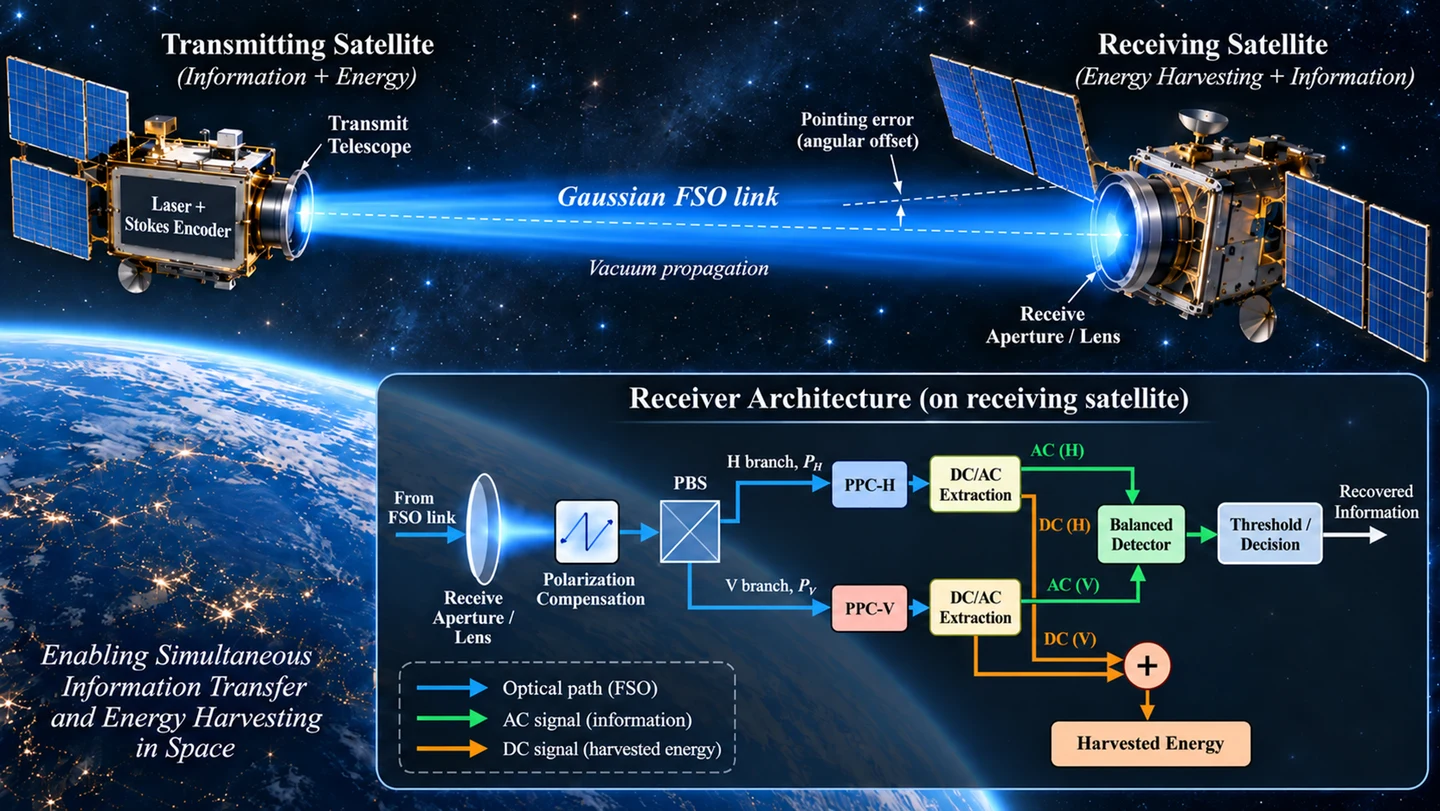
The proposed link carries binary information in polarization while keeping total launched optical power constant. A polarizing beam splitter feeds two matched photonic power converters: their differential AC currents recover data, while their DC outputs supply harvested energy. With matched nonlinear converter responses, changing the symbol exchanges the two branch powers and leaves their summed harvested output unchanged. This removes an explicit optical information–energy allocation ratio; optical losses, conversion inefficiency and receiver-electronics power still matter.
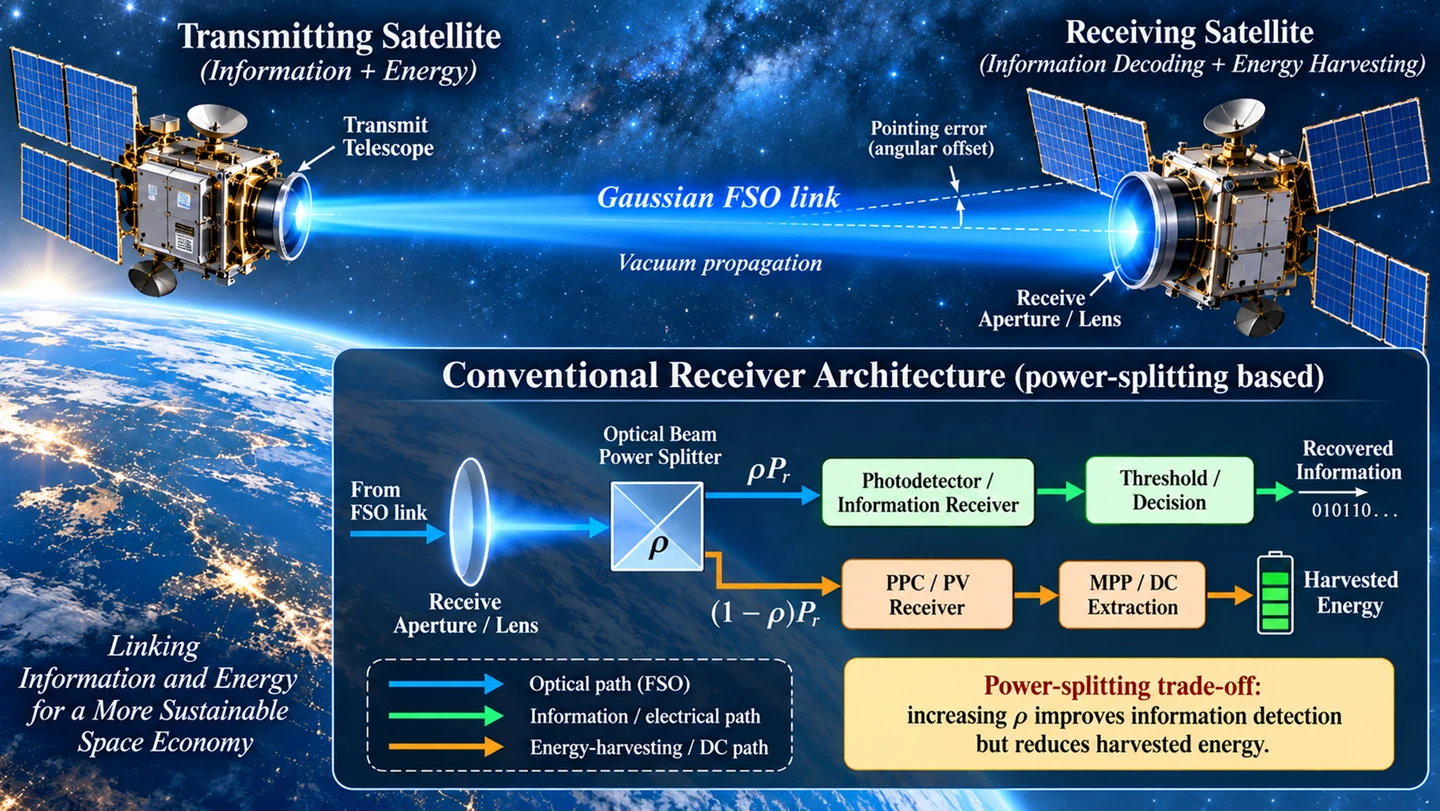
Conventional power-splitting baseline
Move information into polarization
A conventional optical power splitter sends one fraction of received light to an information detector and the remainder to a photovoltaic converter. Increasing the information share generally improves detection while reducing the harvesting share. The proposed architecture uses a constant-power, binary Stokes-orthogonal alphabet instead: the two symbols change the polarization state, while the total launched power stays fixed.
Following receiver-side polarization compensation, a polarizing beam splitter separates complementary horizontal and vertical powers. Both branches are photoconverting devices. Their balanced AC difference carries information, and DC extraction supplies energy harvesting. The polarizing beam splitter separates polarization states; it does not reserve one optical branch exclusively for data and another exclusively for energy.
Manuscript · Sections I–II and IV-A; Fig. 1; Eqs. (1)–(2), (10)–(15)
Why nonlinear harvesting remains symbol invariant
For a fixed received power and polarization contrast, the two symbols exchange the high and low branch inputs. If both converters and maximum-power-point controllers have the same transfer function g, their combined output is g(cP) + g(ℓP) for either symbol. This symmetry holds for a nonlinear g; it does not require a constant conversion efficiency.
The result is conditional on received optical power. It does not make harvested energy independent of pointing loss or polarization contrast, and it does not mean that the complete spacecraft link consumes zero energy. Unequal converter responses can restore symbol dependence, which the paper expresses as a difference of incremental branch responses.
Energy-extraction timescale also matters. A controller following the individual branch levels uses the quasi-static sum g(cP) + g(ℓP). For fast balanced signaling relative to extraction dynamics, each converter sees average input P/2 and the output is 2g(P/2). The paper distinguishes these regimes rather than treating them as equivalent for nonlinear converters.
Manuscript · Section VI-B–C; Eqs. (36)–(39)
Keep pointing, detector noise and conversion in the model
The vacuum link includes Gaussian diffraction, finite circular-aperture collection and residual Gaussian pointing jitter. Exact aperture coupling provides the numerical reference, while an equivalent-beam approximation supports tractable fading averages. The collection law already includes geometric loss, so an additional inverse-square or aperture-area factor would count it twice.
Balanced detection retains signal-dependent shot noise and a nonzero floor from background, dark current, thermal and amplifier terms. Under equal symbol priors and matched Gaussian-noise branches, the zero-threshold decision is maximum likelihood even after averaging over unknown channel gain. A normalized noisy current ratio is not assumed to be automatically optimal.
Average BER is evaluated with one-dimensional integrals for both aperture models. The thermal-dominated and shot-dominated closed forms have stated validity conditions and do not replace the full integral outside those regimes. Nonlinear maximum-power-point harvesting uses an ideal multi-junction single-diode model expressed with the principal Lambert-W function.
Manuscript · Sections III–VI-A; Eqs. (3)–(35)
What the numerical comparison supports
The declared baseline uses 1530 nm light, 100 km range, 2 W launch power, a 25 mm transmitter beam radius, a 100 mm receive-aperture radius, 2 µrad per-axis pointing jitter and a 20 dB polarization extinction ratio. Transmitter, receiver and PBS efficiencies are 0.80, 0.80 and 0.95. The detector model uses 1 GHz bandwidth, 293.15 K temperature, a 25 Ω load and 30 nA dark current per branch; background and amplifier noise remain model parameters.
The BER power sweep separately uses 6, 8 and 10 µrad per-axis jitter. A BER near 10⁻² is reached at approximately 13, 17 and 23 dBm launch power respectively, illustrating the stronger-power requirement under larger pointing fluctuations. The manuscript reports that its closed-form BER approximation stays within 0.43% of the exact evaluation over the examined conditions; this is a tested approximation result, rather than a universal error bound.
At the separate 36 dBm comparison point and 8 µrad per-axis jitter, the proposed scheme reports about 2.31 mW average harvested power at BER 1.6 × 10⁻⁵. An ideal power-splitting benchmark point is about 1.81 mW at BER 1.7 × 10⁻⁴. At 10 µrad, the reported comparison is approximately 1.87 mW at BER 5.8 × 10⁻⁴ versus 1.46 mW at BER 2.7 × 10⁻³. These are numerical operating points under the same declared comparison conditions.
Pointing still reduces both collected energy and communication reliability. For example, at 30 dBm launch power, the harvested-power map falls from about 0.870 mW at 1 µrad per-axis jitter to 0.271 mW at 14 µrad. Avoiding the explicit allocation ratio does not remove this physical sensitivity.
Manuscript · Section VII; Figs. 2–4
Requirements for a physical implementation
The symmetric baseline assumes tracked polarization compensation, matched converters and suitable AC/DC extraction. Time-varying uncompensated polarization, polarization-dependent loss and branch mismatch require additional treatment. The Gaussian shot-noise approximation also needs enough detected photoelectrons; a photon-starved receiver should use a joint Poisson model.
The photovoltaic model is calibrated to a representative literature maximum-power point and uses declared four-junction assumptions. A specific device needs measured spectral response and converter/controller characterization. The paper establishes an analytical and numerical baseline, without demonstrating this inter-satellite architecture in flight or proving net electrical power neutrality for all terminal electronics.
Manuscript · Sections II-A–B, IV-B, VI and VIII
Publication record
- Authors
- Meysam Ghanbari, Mohammad Taghi Dabiri, Mazen O. Hasna, Khalid A. Qaraqe
- Venue
- International Conference on Digital Transformation and Intelligent SOciety (DTISO 2026)
- Location
- Barcelona, Spain
- Status
- Submitted
- Year
- 2026
The exact title, abstract, author order and technical explanation follow the supplied arXiv:2609.25986v1 manuscript dated 22 September 2026. Meysam Ghanbari has confirmed a forthcoming presentation at DTISO 2026 in Barcelona, 17–20 November 2026. This source updates the earlier power-neutral/Stokes research entry while retaining its existing URL. An individual session slot and proceedings DOI are not yet recorded. The technical explanation is editorial and separate from the original abstract. Research note updated 2026-10-10.