Abstract
Original text · supplied accepted manuscript
This paper investigates terahertz (THz) coverage using fixed-wing unmanned aerial vehicles (UAVs), where severe free space path loss, atmospheric absorption, and beam misalignment effects create significant coverage holes. To overcome the high computational cost of Monte Carlo based coverage evaluation, a coverage analysis framework is developed that incorporates circular trajectory parameterization and a composite THz channel including line-of-sight probability, absorption loss, beam misalignment, and small-scale fading. A new closed-form outage probability expression is derived for each grid cell, enabling fast and accurate coverage computation. Using this analytical model, a trajectory-parameter analysis framework is developed to evaluate altitude–radius configurations to minimize coverage holes over the target area. Simulation results validate the exact match between the proposed closed-form and Monte Carlo evaluations and reveal several interesting behaviors for fixed-wing UAVs, including optimal altitude–radius pairs and nontrivial coverage patterns. The proposed framework enables efficient trajectory design and reliable THz coverage with fixed-wing UAV platforms.
ENGINEERING QUESTION
How can circular fixed-wing UAV trajectories be evaluated for THz coverage without repeating expensive Monte Carlo fading simulations for every candidate?
The paper derives a closed-form composite-channel outage model for each ground grid cell and uses it to compare circular-flight altitude and radius choices. The study balances line-of-sight probability, atmospheric loss, directional beam misalignment and fading. Its coverage and timing results are conditional numerical evaluations of a modeled four-UAV deployment.
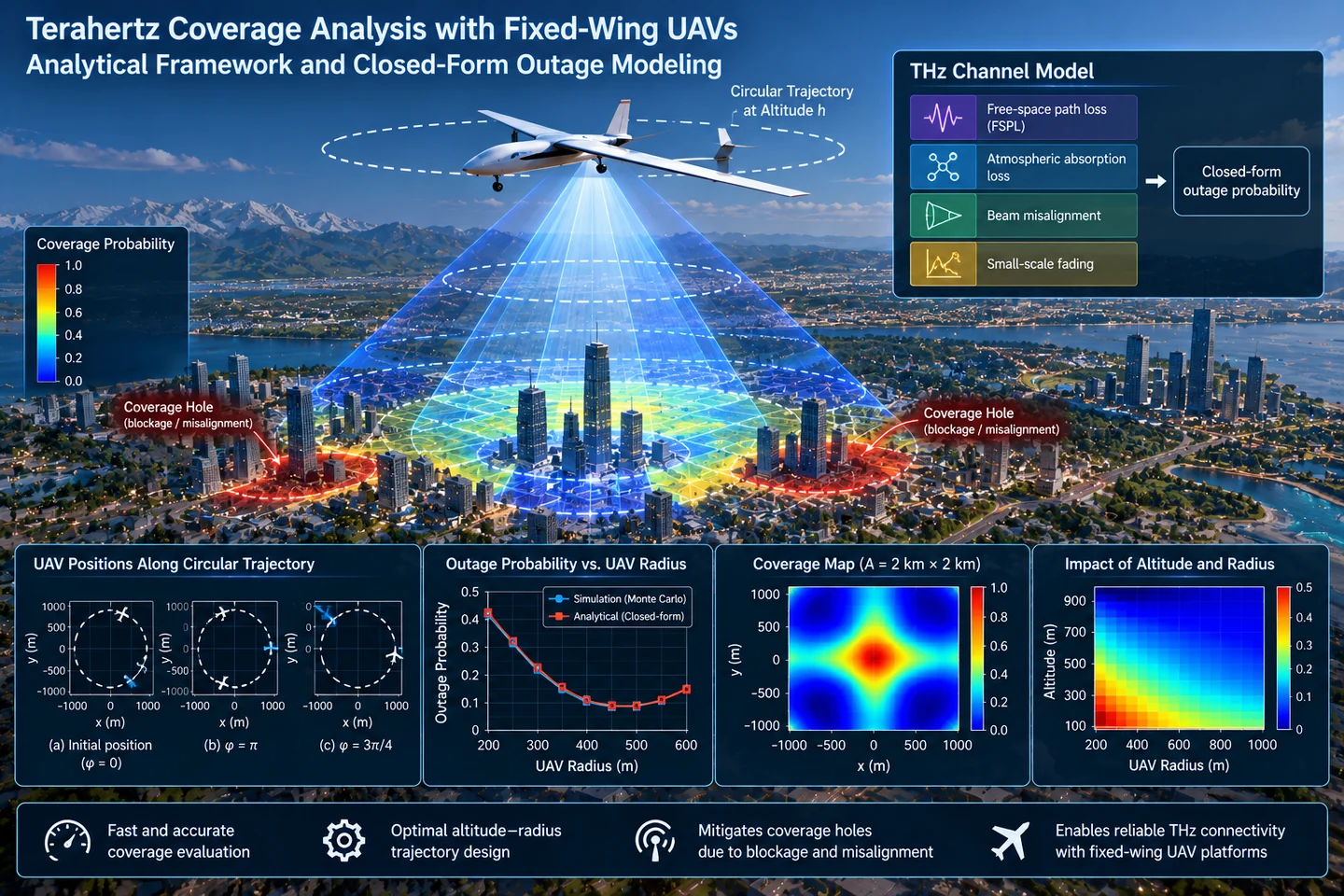
Network geometry and composite THz channel
Fixed-wing platforms continuously move rather than hover. The model parameterizes each circular path by center, altitude, radius, angular speed and initial phase. Ground coverage is evaluated at grid-cell centers, with service determined by the best available UAV link and a target-rate threshold.
The channel combines deterministic free-space and absorption loss, probabilistic line of sight, directional beam-misalignment fading and α–µ small-scale fading. Non-line-of-sight links count as outage. Atmospheric emissivity determines a frequency-dependent noise term. Independent links, negligible co-channel interference and unobstructed belly-mounted antenna placement are assumed.
Manuscript · Sections II–III-A; Eqs. (1)–(22)
Closed-form outage and trajectory-parameter selection
The derivation converts the rate requirement into an SNR threshold, then combines line-of-sight occurrence with a closed-form composite-channel CDF involving Whittaker functions. With independent UAV links, a ground cell is in outage when all candidate links fail. The analytical expression replaces random fading generation during repeated coverage evaluation.
The paper formulates coverage-hole minimization with area, turning-radius and collision constraints. Its numerical study specializes this broader formulation to symmetric UAV centers and geometrically chosen phase offsets, then evaluates altitude–radius pairs. It does not demonstrate a global optimizer over every center, phase and flight parameter.
Manuscript · Section III; Proposition 1; Eqs. (23)–(42); Appendix
Validation conditions and computational comparison
The evaluated area is 2 km × 2 km, divided into 50 m × 50 m cells and served by four fixed-wing UAVs. Link parameters include 300 GHz carrier frequency, 2 GHz bandwidth, 30 dBm transmit power, 29 dBi total effective antenna gain and a 16 × 16 array configuration. Monte Carlo comparisons use 500,000 random realizations.
For the reported fading evaluation across the grid, the manuscript gives an average Monte Carlo time of 21.59 s and an analytical time of 3.56 ms on an Intel Core i9-13900 workstation with 64 GB RAM. This is a reported computation benchmark for the evaluated channel task, not a measured radio-network latency or a guaranteed speedup on every processor.
Manuscript · Section IV; Table I; Figs. 2–4
Coverage results and their engineering interpretation
The results show that higher altitude is not always better: improving line of sight must be balanced against increased link distance and misalignment-sensitive gain. Instantaneous coverage patterns also change with the relative positions along the circular paths. The best radius for one cell or one phase need not minimize holes across the full area and complete rotation.
Under the paper’s evaluated coverage-hole criterion, an altitude of 650 m and radius of 200 m give the highest reported coverage percentage, 98.50%, across the tested full-motion configurations. A grid is classified as a hole when its outage probability exceeds 0.1. These numbers are conditional on the stated geometry, hardware parameters, channel distributions and thresholds; they are not universal flight settings.
Manuscript · Section IV; Figs. 3–7
Scope and limitations
The evidence is analytical modeling and simulation, not a flight campaign or a built UAV-mounted THz transceiver. The authors explicitly treat the power, gain and array values as system-level link-budget assumptions; practical integration needs separate RF hardware design, fabrication and testing.
Independence, negligible interference, probabilistic blockage and simplified flight geometry limit transfer to crowded or correlated deployments. The study evaluates feasible altitude–radius candidates in a symmetric layout and does not establish terrain-specific coverage, handover delay, flight-control behavior or end-to-end network throughput. The analytical model should be checked against the intended service threshold and deployment conditions before operational use.
Manuscript · Sections II and IV; Section V
Publication record
- Authors
- Mikail Erdem, Mohammad Taghi Dabiri, Meysam Ghanbari, Mazen Omar Hasna, Khalid Qaraqe
- Venue
- IEEE Transactions on Vehicular Technology
- Status
- Published
- Year
- 2026
- Pages
- 1-10
- DOI
- 10.1109/TVT.2026.3717678
The original abstract, full author list and technical explanation follow the supplied accepted author manuscript. The DOI and Early Access pagination are verified against the publisher record; no final volume or issue is assigned in that record. The technical explanation is editorial and separate from the original abstract. Research note updated 2026-10-03.