Abstract
Original text · supplied manuscript
Directional links in free-space optical (FSO), millimeter-wave (mmWave), and terahertz (THz) systems are a cornerstone of emerging 6G networks, yet their reliability is fundamentally limited by pointing errors and misalignment. Existing studies address this impairment using technology-specific definitions, models, and mitigation approaches, which hinders cross-domain comparison and transferable design insight. This survey provides a unified treatment of pointing errors across optical and high-frequency wireless communications. We establish consistent terminology and a cross-technology taxonomy of pointing errors, review angular misalignment and statistical distribution models, and analyze their impact on system performance. Mitigation techniques are systematically surveyed with emphasis on optical systems and their connection to underlying pointing-error models. The survey further provides a detailed examination of pointing-error effects in orbital angular momentum (OAM) links and quantum optical communications, and surveys the corresponding mitigation approaches tailored to mode-dependent impairments and quantum measurement constraints. The survey also outlines open challenges and future research directions. By consolidating fragmented literature into a coherent framework, this work supports consistent analysis and robust design of next-generation directional communication systems.
ENGINEERING QUESTION
Why must narrow-beam FSO, mmWave and THz links be designed around alignment dynamics rather than ideal beam gain alone?
Higher directivity concentrates useful power but makes the link sensitive to platform motion, tracking delay and receiver orientation. The survey connects terminology, geometric and statistical models, performance metrics and mitigation choices across technologies, while showing why optical aperture loss cannot simply stand in for every RF antenna or quantum measurement impairment.
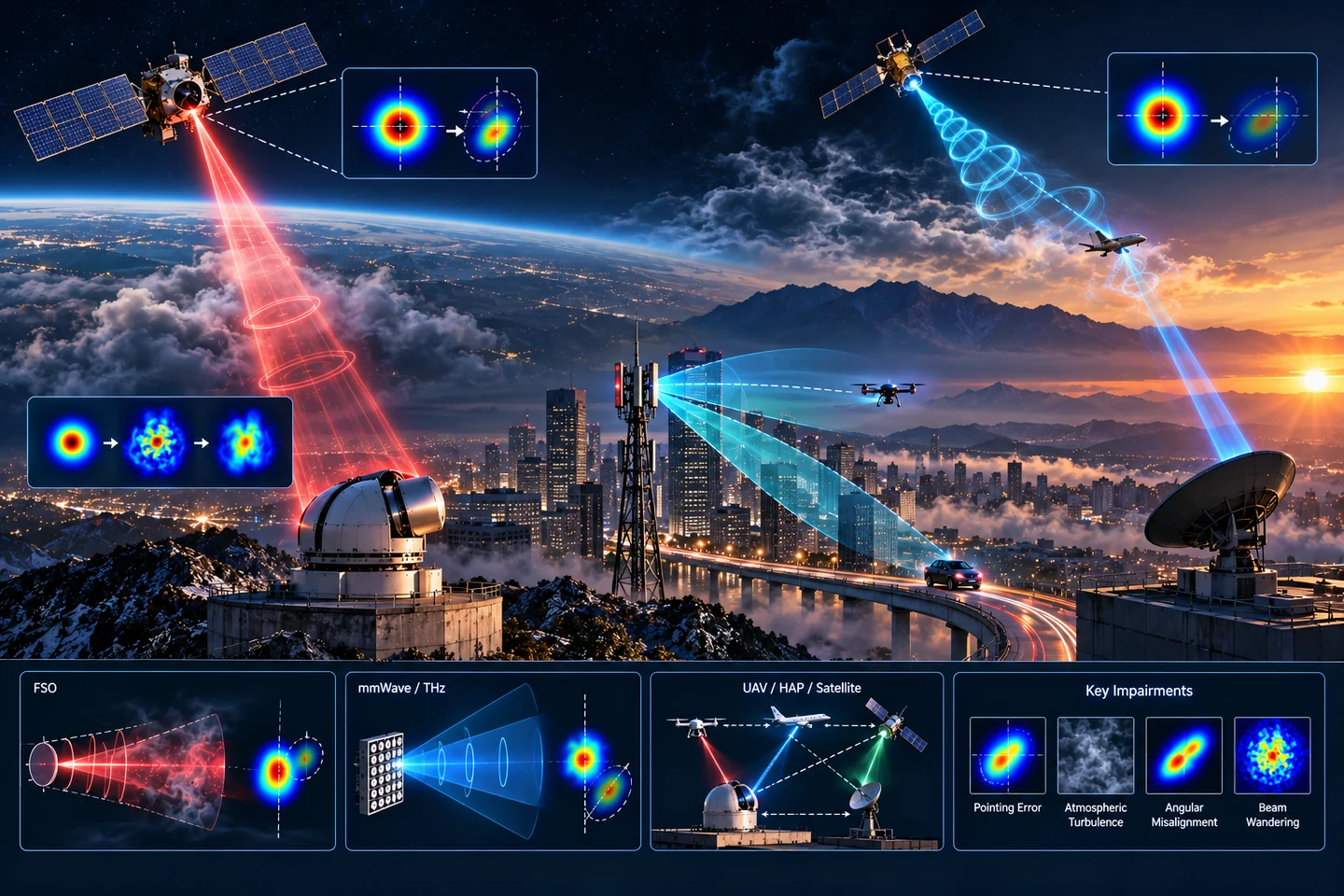
Scope and contribution of the survey
The paper organizes a fragmented body of literature around a common sequence: define the impairment, describe its geometry and dynamics, select a statistical model, evaluate the relevant system metric, and match a mitigation mechanism to the modeled error. Its contribution is cross-technology synthesis and design guidance, rather than a new terminal experiment or one universal performance gain.
The scope covers conventional and mobile FSO, mmWave and THz links, with extended treatment of OAM and free-space quantum communication. Tables I–III compare earlier surveys, establish terminology and define notation. Tables IV–VI consolidate OAM modeling, OAM mitigation and quantum-link studies.
Manuscript · Sections I–II; Tables I–III and IV–VI
A taxonomy that distinguishes physically different errors
Transmitter pointing error shifts the illumination away from its intended target. Receiver angle-of-arrival variation can move a focused spot away from a detector or fiber core even when the receiving lens still collects light. Beam wander describes propagation-induced displacement; platform wobble describes time-varying orientation. These mechanisms require different measurements and corrective actions.
The survey also discusses frequency-dependent beam squint in wideband RF arrays, polarization-frame mismatch, cross-polarization interference, chromatic effects and OAM mode crosstalk. These are related alignment phenomena, but treating them all as one scalar power-loss coefficient can omit the impairment that actually limits a system.
Manuscript · Section II; Table II; Fig. 2
Optical aperture loss and RF antenna gain are different modeling primitives
For mobile FSO, the survey separates geometrical aperture collection from angle-of-arrival-dependent focal-plane coupling. The former integrates a displaced optical intensity profile over the receiver aperture; the latter depends on focusing optics, detector geometry and field of view. The familiar Gaussian-beam pointing approximation is useful only under its stated geometry and beam-to-aperture assumptions.
For directional mmWave/THz links, both transmitter and receiver antenna patterns contribute to misalignment loss. The reviewed choices range from full array patterns to two-sector, multi-sector and Gaussian main-lobe approximations. A two-sector abstraction is convenient but can miss sidelobe and transition behavior. Gaussian main-lobe approximations should not be extrapolated to large angular deviations without checking the real pattern.
Manuscript · Section IV; Eqs. (1)–(25); Figs. 6–9
Statistics must reflect platform and tracking dynamics
The distribution review distinguishes zero-boresight radial jitter, nonzero-boresight and unequal-axis models, and extensions for mobile, relayed and aerial systems. A marginal pointing-loss distribution can support outage or BER analysis, but does not by itself describe acquisition delay, temporal bursts of misalignment or the behavior between tracking updates.
The survey reviews Gaussian, impulsive, bounded and state-dependent tracking descriptions, and highlights stabilizer response speed and accuracy. Balloon pendulum motion and rotation illustrate how orientation changes can affect coverage and handovers. A control loop should be assessed against the disturbance time scale and the platform’s mass, power and actuation limits.
Manuscript · Sections III and V; Figs. 3–5
Mitigation choices and their engineering trade-offs
Coarse gimbal pointing and fine steering mirrors address different angular ranges. Detector arrays provide angular evidence for feedback. Beam divergence control exchanges peak collected power for misalignment tolerance. Beacon-assisted links move part of the tracking burden to a better-resourced terminal; modulating retroreflectors reduce the remote transmitter burden while retaining demanding acquisition and round-trip link-budget constraints.
Diversity and signal processing complement physical alignment control. Their value depends on correlation, sensing overhead, computational cost and the channel model. The design question is therefore which combination maintains useful link performance under the available hardware and timing budget, rather than which isolated technique has the highest ideal precision.
Manuscript · Section VI; Figs. 13–17
OAM and quantum links require metrics beyond collected power
In OAM links, lateral shifts and tilt change modal overlap, producing crosstalk as well as power loss. The survey reviews mode-dependent models and physical, coding, equalization and learning approaches. Aperture size, beam waist, mode spacing and propagation distance jointly determine tolerance; increasing the number of modes does not guarantee an unrestricted capacity benefit.
For free-space quantum links, the relevant outcomes include detected photon rates, QBER, secret-key rate and protocol-specific fidelity. Polarization rotation, spatial coupling and modal distortion must be distinguished. The review includes theoretical proposals and experiments from earlier literature; those experiments are evidence for the cited studies, not new demonstrations performed for this survey.
Manuscript · Section VII-C–F; Tables IV–VI; Figs. 18–20
Network-level implications and open research questions
The survey argues that optical inter-satellite alignment should inform route availability and path stability in LEO meshes. It also discusses pointing-aware direct-to-device NTN design, where device orientation, platform steering and resource management interact. These are research directions and conceptual architectures; the paper does not validate a deployed multi-provider constellation or a universal high-frequency handset link.
The open agenda includes dynamic cross-technology models, coupling of pointing with beam training and recovery, physics-informed learning, cross-layer optimization, high-mobility scenarios, OAM and quantum effects, and reproducible experimental datasets. Any quoted gain or threshold from a reviewed study remains conditional on that study’s optics, antenna pattern, channel, protocol and evaluation method.
Manuscript · Section VII-G–H; Figs. 21–22; Section VIII
How to use the survey and what it does not establish
The framework can help a designer identify omitted error sources, choose a model appropriate to the platform and receiver, and connect a mitigation option to measurable performance. The consolidated literature should be used as a map to the underlying references when selecting numerical design limits.
The supplied manuscript does not supply a shared experimental benchmark across all three technologies. Its reviewed numerical examples and prior-study results do not establish one transferable alignment tolerance, one best control method or a general security guarantee. The need for measured datasets and fair benchmarking is itself a stated research gap.
Manuscript · Sections VIII–IX
Publication record
- Authors
- Meysam Ghanbari, Mohammad Taghi Dabiri, Osamah S. Badarneh, Mazen Hasna, Yazan H. Al-Badarneh, Mustafa K. Alshawaqfeh, Khalid Qaraqe
- Venue
- IEEE Open Journal of the Communications Society
- Status
- Published
- Year
- 2026
- Volume
- 7
- Pages
- 4959-5006
- DOI
- 10.1109/OJCOMS.2026.3690915
The original abstract, author spelling and technical explanation follow the supplied survey manuscript. The published journal DOI, volume and pages are verified separately against the publisher record. The final author is listed as Khalid Qaraqe in the supplied title block and Khalid A. Qaraqe in the formal citation. The technical explanation is editorial and separate from the original abstract. Research note updated 2026-10-03.