Abstract
Original text · supplied manuscript
We consider outdoor optical access points (OAPs), which, enabled by recent advances in metasurface technology, have attracted growing interest. While OAPs promise high data rates and strong physical-layer security, practical deployments still expose vulnerabilities and misuse patterns that necessitate a dedicated monitoring layer—the focus of this work. We therefore propose a user positioning and monitoring system that infers locations from spatial intensity measurements on a photodetector (PD) array. Specifically, our hybrid approach couples an optics-informed forward model and sparse, model-based inversion with a lightweight data-driven calibration stage, yielding high accuracy at low computational cost. This design preserves the interpretability and stability of model-based reconstruction while leveraging learning to absorb residual nonidealities and device-specific distortions. Under identical hardware and training conditions (both with 5 × 10⁵ samples), the hybrid method attains consistently lower mean-squared error than a generic deep-learning baseline while using substantially less training time and compute. Accuracy improves with array resolution and saturates around 60 × 60–80 × 80, indicating a favorable accuracy–complexity trade-off for real-time deployment. The resulting position estimates can be cross-checked with real-time network logs to enable continuous monitoring, anomaly detection (e.g., potential eavesdropping), and access control in outdoor optical access networks.
ENGINEERING QUESTION
Can an optical access point locate multiple interrogating transmitters from overlapping intensity spots and flag unexplained activity?
The proposed monitoring module maps incoming residual beams onto a photodetector array. A lightweight heatmap network, peak extraction, optimal correspondence and geometric inversion estimate source locations; comparison with authorized network records can then indicate unexplained transmitters. The reported positioning gains come from synthetic Monte Carlo data, not a deployed surveillance or access-control system.
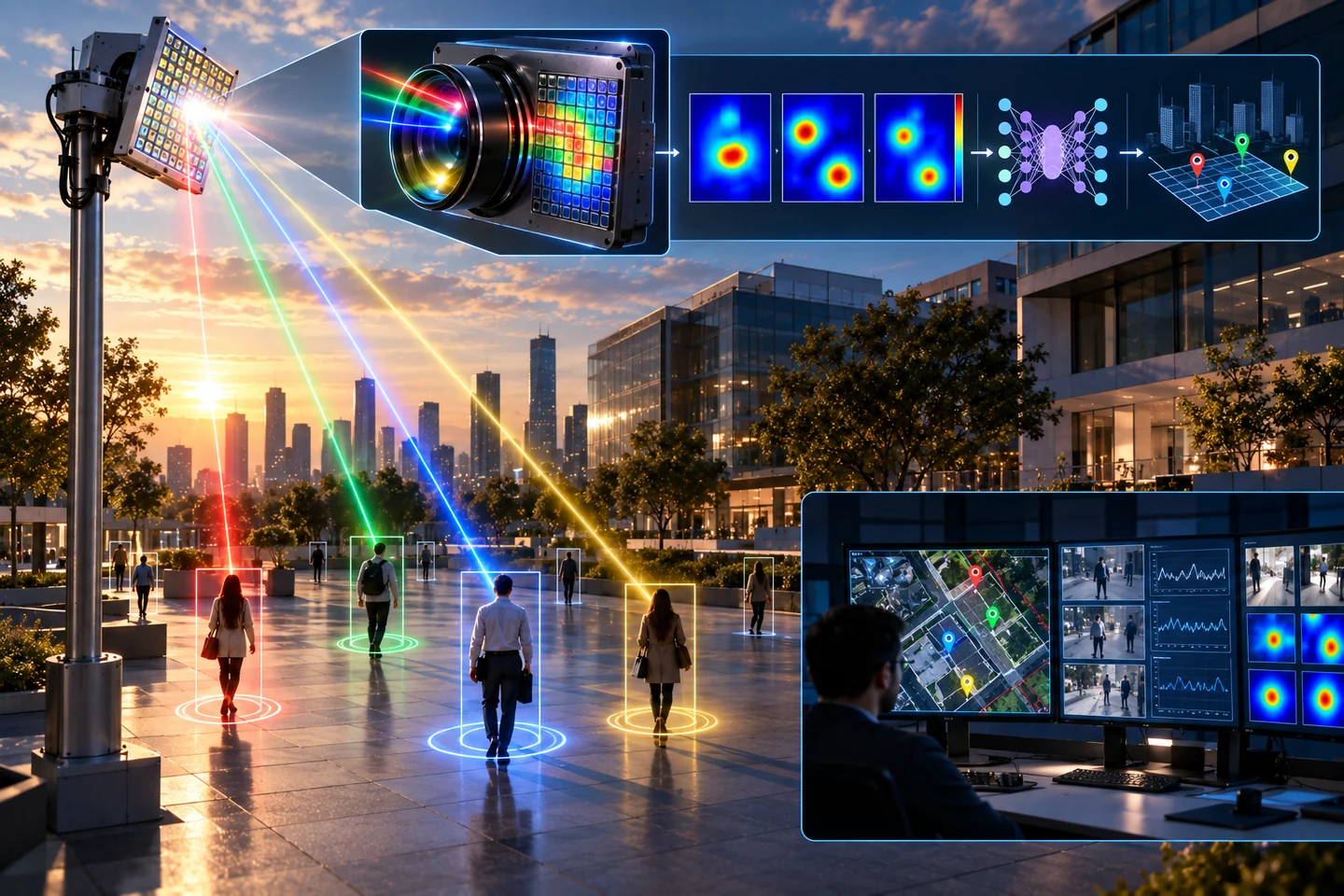
Monitoring architecture and modeled signals
An IRS or modulating retroreflector access point can receive interrogation from an unauthorized transmitter within its field of view. The proposed sensing module uses the residual beam energy that extends beyond the access-point aperture. A wide-field lens and a camera-like photodetector array convert incident directions into spatial intensity patterns.
The model combines Gaussian beam illumination, residual boresight and pointing jitter, Gamma–Gamma turbulence, attenuation, lens transmission and additive thermal noise. A beam much wider than the receiving lens permits a local plane-wave approximation. Source powers add on the sensing array, where close incident directions can produce merged or overlapping spots.
Manuscript · Sections II–III; Fig. 1; Eqs. (1)–(16)
Hybrid inference, assignment and inverse geometry
A shallow convolutional network produces an identity-free heatmap. Non-maximum suppression extracts candidate centroids. The manuscript defines a linear assignment problem for one-to-one correspondence, with Euclidean costs in the homogeneous case, uncertainty-weighted costs for unequal blur and dummy nodes for missed or spurious detections. The assignment is optimal for its chosen cost, not a proof that the full learned pipeline recovers every source correctly.
Inverse angle-to-sensor mapping converts centroids into incident angles and lateral ground coordinates using the known platform height. The supplied formulation uses true centroids to define and evaluate correspondence; an operational identity association would require an available reference such as claimed positions or network records. Geometry alone does not identify a transmitter or prove malicious intent.
Manuscript · Section IV; Eqs. (17)–(20)
Simulation conditions and reported comparison
The Monte Carlo study uses a 300 m access-point altitude, a 250 × 250 m ground region, 1 W interrogator power, a 0.6 m beam radius and five to nine simultaneous transmitters. Array resolutions range from 10 × 10 to 100 × 100. Both the proposed method and the end-to-end baseline are trained with 500,000 synthetic samples under the same reported hardware conditions.
Table I reports positioning MSE of 0.9 m² for the hybrid method versus 2.3 m² for the baseline at 60 × 60 pixels. The hybrid values change to 0.84 m² and 0.81 m² at 80 × 80 and 100 × 100, showing diminishing returns in this setup. These are mean-squared positioning errors, not guaranteed maximum errors or measured field accuracy. The manuscript reports approximately twice the training time for the baseline.
Manuscript · Section V; Table I; Fig. 3
Engineering interpretation and limitations
The central benefit is optical situational awareness: a spatial estimate can be checked against authorized transmissions and claimed positions. This can support anomaly indication, while separate network logic determines authorization and any response. Strongly overlapping signatures remain difficult; the manuscript’s example with closely spaced sources has larger localization errors.
The evidence is synthetic simulation. The manuscript does not report field tests, attack-classification precision or recall, an end-to-end access-control experiment, or a measured inference latency. Its default sensing integration is one second, so the faster training comparison does not establish a sub-millisecond operational monitor. Atmospheric, blur and device assumptions require calibration before transfer to hardware.
Manuscript · Sections III–V; Fig. 3
Publication record
- Authors
- Meysam Ghanbari, Mohammad Taghi Dabiri, Rula Ammuri, Mazen Hasna, Khalid Qaraqe
- Venue
- 2026 IEEE International Conference on Communications (ICC)
- Location
- Glasgow, United Kingdom
- Status
- Published
- Year
- 2026
- Publication date
- 2026-05
- Pages
- 1-6
- DOI
- 10.1109/ICC59461.2026.11587943
The original abstract, author spelling and technical explanation follow the supplied arXiv v1 manuscript (19 December 2025). The ICC 2026 DOI, pagination and Glasgow location are verified separately against the publisher record. The technical explanation is editorial and separate from the original abstract. Research note updated 2026-10-03.