Abstract
Original text · published article
This paper presents a novel wireless quantum synchronization framework tailored for city-scale deployment using entangled photon pairs and passive corner cube retroreflector (CCR) arrays. A centralized quantum hub, equipped with either a bulk or integrated nonlinear entangled-photon source, emits photon pairs and directs one photon toward a target device while routing its twin to a local reference unit. The target, equipped with a planar CCR array, reflects the incoming photon without active circuitry, enabling secure round-trip quantum measurements for sub-nanosecond synchronization and localization. We develop a comprehensive analytical model that captures key physical-layer phenomena, including Gaussian beam spread, spatial misalignment, atmospheric turbulence, and probabilistic photon generation. A closed-form expression is derived for the single-photon detection probability under Gamma-Gamma fading, and its distribution is used to model photon arrival events and synchronization error. Moreover, we analyze the impact of background photons, SPAD detector jitter, and quantum generation randomness on synchronization accuracy and outage probability. Simulation results confirm the accuracy of the analytical models and reveal key trade-offs among beam waist, CCR array size, and background light. The proposed architecture offers a low-power, infrastructure-free solution for secure timing in next-generation smart cities.
ENGINEERING QUESTION
How can a quantum hub obtain precise round-trip timing from a remote target that carries no powered optical receiver?
The paper proposes a central entangled-photon hub that records a local reference photon and the return of its partner from a passive corner-cube array. It derives photon-detection, timing-error and outage models, then validates them against Monte Carlo simulations. Precision depends on collected signal photons, hub-side tracking, background light and detector jitter; the evaluated 500 m line-of-sight link is a physical-layer benchmark rather than a deployed city network.
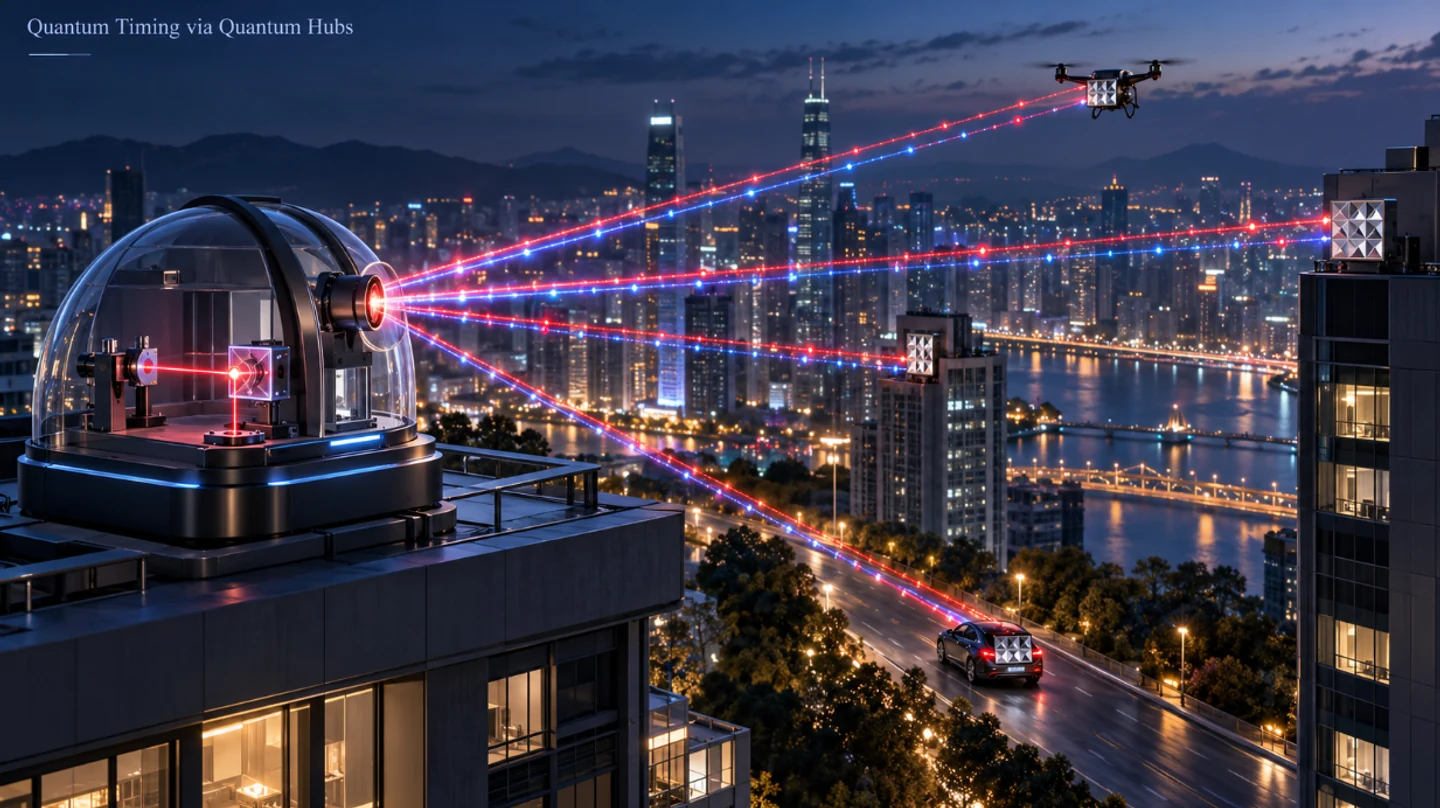
Central quantum hub and passive target
An entangled-photon source at the hub sends one member of each pair toward the target while routing its partner to a local reference detector. A planar corner-cube retroreflector array returns intercepted light toward the hub. Single-photon avalanche detectors record polarization bits and arrival times for the reference and returned photons.
Photon generation, detection, optical steering and processing remain at the hub. The target requires passive reflectors rather than a local photon source, detector or alignment actuator. The source is modeled through effective time-bin rate and pair-generation probability, accommodating bulk SPDC, integrated SPDC or integrated SFWM implementations. “Infrastructure-free” in the original abstract describes the proposed endpoint flexibility; hub optics and a clear optical path are still required.
Manuscript · Sections I–II; Figs. 1–2; Eqs. (9)–(16)
Acquisition, tracking and the moving-target condition
Initial acquisition scans a rectangular grid around a coarse position estimate. After detecting the array, the hub enters closed-loop tracking using returned-photon statistics or an auxiliary beacon. Coarse acquisition, residual steering error and motion during the update interval contribute to the aggregate receiver-plane spatial uncertainty.
The motion bound is transverse velocity multiplied by the update interval plus half the transverse acceleration multiplied by its square. This displacement must remain small relative to the beam waist and effective CCR capture region. Retroreflection simplifies the return direction after interception, but it does not make an outgoing beam hit a missed target or remove the need for hub-side tracking and re-acquisition.
Manuscript · Section II-B; Section IV; Eqs. (1)–(8)
Photon-level channel and statistical approximations
The channel combines Gaussian beam overlap with individual CCR apertures, diffraction-limited return capture, round-trip atmospheric attenuation, optical coupling loss, Gamma–Gamma turbulence and SPAD detection efficiency. The reception probability is a spatially weighted sum over CCR paths. The model then connects this random probability to Poisson photon counts.
The conditional reception distribution uses a central-limit Gaussian approximation to the weighted sum of independent fading terms. Its applicability depends on sufficiently many independent, non-dominant CCR contributions; Appendix B relates independence to element separation and turbulence coherence length. Spatial-offset marginalization remains numerical, and a one-axis radial approximation reduces computation. These approximations require checking for the intended array geometry and turbulence conditions.
Manuscript · Section III; Propositions 1–2 and 4; Appendices A, B and D
What the timing estimator measures
The reference and received records contain valid polarization bits and timestamps, with null entries for missing or ambiguous events. The source model retains single-pair intervals; background photons are modeled as random arrivals within each time bin. After sequence alignment, the estimator averages differences between returned and reference timestamps to estimate round-trip propagation delay.
The paper assumes successful sequence matching for its timing-error analysis. Its variance model combines independent detector jitter, background arrival-time uncertainty and random signal/background counts. An insufficient-detection threshold defines outage. This is a model of hub-side round-trip timing and related ranging; transferring a clock correction into a fully passive remote device requires an additional system mechanism.
Manuscript · Sections II-D and IV; Propositions 3–4; Eqs. (28)–(39); Appendix C
Validation conditions and numerical findings
The main numerical link is 500 m at 1550 nm, with an 8 × 8 CCR array, a 5 cm receive-aperture radius, SPAD efficiency 0.6, detector jitter of 50 ps, a 100 µs acquisition interval and a 1 GHz source-side time-bin rate. The default mean pair number is 0.5 per interval; this rate is not one successfully delivered photon pair in every bin. Monte Carlo validation uses 10,000 spatial-offset realizations and 500,000 fading samples in the stated comparisons.
Smaller beam waists increase photon density but make low-count events more likely under misalignment. Wider beams improve spatial tolerance while lowering the peak received count, so the best waist changes with spatial uncertainty. Larger CCR arrays improve timing accuracy with diminishing returns. Background contamination becomes more damaging when received signal counts fall; suppressing background further gives little benefit once signal counts dominate.
The analytical distributions, timing-error trends and outage estimates closely match the reported simulations. The article discusses high reliability and picosecond error under selected 500 m conditions. These are model-dependent numerical results, not measured timing performance for arbitrary urban traffic, weather or link range.
Manuscript · Section V; Table III; Figs. 4–8
Deployment trade-offs and limits of the evidence
Spectral filtering, narrow spatial acceptance and time gating can suppress background photons, but their implementation must be balanced against pointing and angle-of-arrival tolerance. Multi-pair events are mitigated statistically through operation and post-processing; they cannot be identified perfectly when detection efficiency is below unity. Source preparation losses, CCR contamination and optical thermal drift also require engineering attention.
Complete obstruction is blockage rather than ordinary turbulence fading. Distributed hubs, relays and handover are proposed ways to extend coverage, while 1–5 km links require different aperture, photon-flux and tracking budgets. The paper does not demonstrate a built city network, multi-target handover, an end-to-end remote-clock update or an adversarial security proof. The passive target reduces endpoint power needs; the hub remains an active optical and computing installation.
Manuscript · Section VI; Section VII
Publication record
- Authors
- Mohammad Taghi Dabiri, Meysam Ghanbari, Mazen Hasna, Rula Ammuri, Saif Al-Kuwari, Khalid A. Qaraqe
- Venue
- IEEE Journal on Selected Areas in Communications
- Status
- Published
- Year
- 2026
- Publication date
- 2026-07-07
- Volume
- 44
- Pages
- 5388-5403
- DOI
- 10.1109/JSAC.2026.3711027
The original abstract, author list and technical explanation follow the supplied published article. Its first page states publication on 7 July 2026 and the current-version date of 20 July 2026. The DOI, volume and pages are verified against the publisher metadata; no issue number is supplied. The technical explanation is editorial and separate from the original abstract. Research note updated 2026-10-03.