Abstract
Original text · supplied arXiv v1 manuscript (11 September 2026)
This paper proposes a learning-free hierarchical estimator for jointly recovering the angle of arrival (AoA), transmitter pointing error, receiver-induced jitter, and per-aperture turbulence coefficients in a multi-aperture free-space optical system. The proposed method exploits the distinct spatial signatures contained in quad-photodetector measurements. First, normalized quadrant imbalance ratios provide an approximate closed-form AoA estimate. Next, AoA-compensated lens powers are transformed into a log-linear regression model for non-iterative pointing-error estimation. Finally, receiver jitter and turbulence coefficients are directly reconstructed after compensating for the estimated angular losses. The method requires neither neural-network training nor exhaustive multidimensional search and has computational complexity linear in the number of lenses. Monte Carlo results demonstrate robust AoA estimation under Gamma–Gamma turbulence, reveal turbulence-induced error floors in OLS-based pointing and jitter estimation, and show improved turbulence reconstruction with larger arrays and explicit pointing compensation.
ENGINEERING QUESTION
Can an optical receiver separate arrival angle, pointing error, jitter and turbulence without training a neural network?
The study uses two spatial signatures: quadrant imbalance within each detector reveals the angle of arrival, while the power profile across the lens array supports log-linear pointing estimation. Angular compensation then enables receiver-jitter and turbulence reconstruction. The three-stage estimator needs no training and scales linearly with lens count, although unknown aperture turbulence still limits pointing and jitter accuracy.
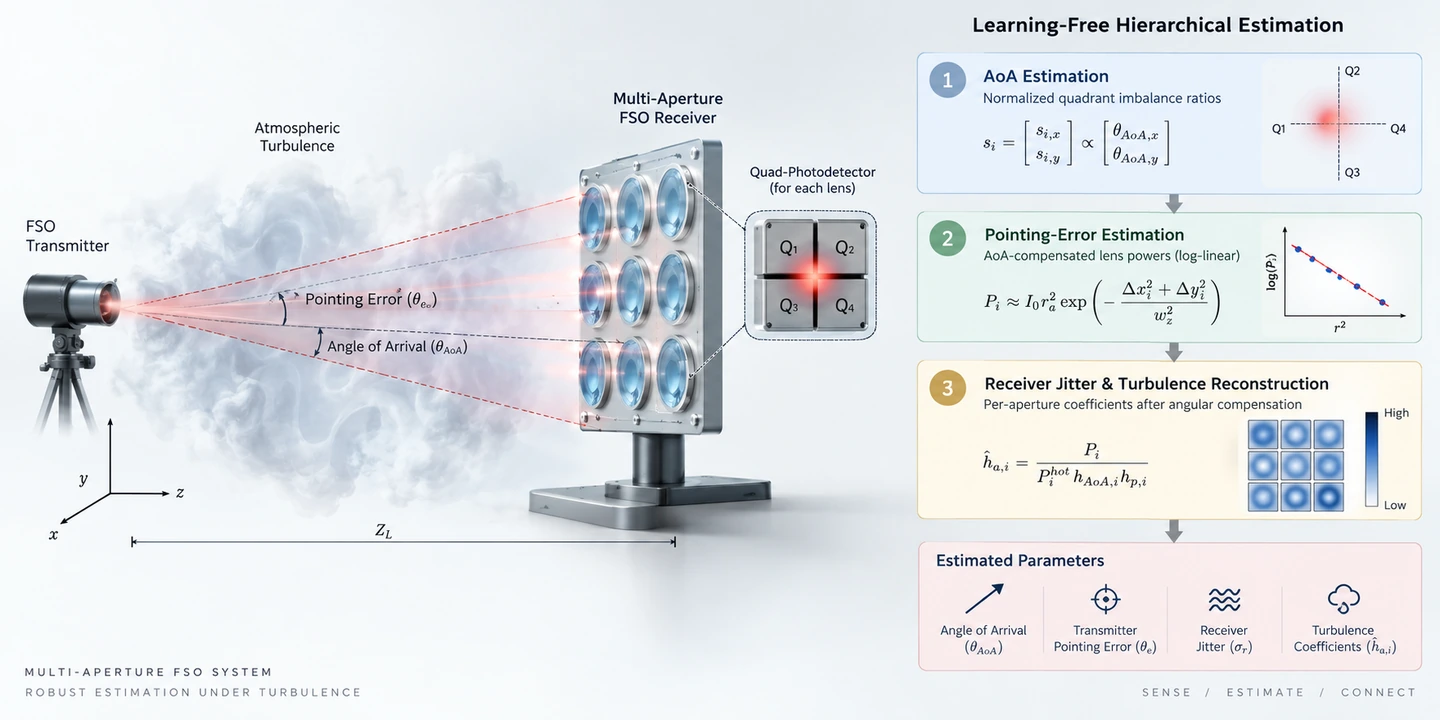
Two spatial signatures, four coupled effects
Each small lens focuses the incident optical beam onto its own quad-photodetector. The relative powers of its four quadrants carry arrival-angle information; the total powers across the lens array carry the spatial footprint of transmitter pointing error. Atmospheric turbulence multiplies the signal within each aperture.
The model treats arrival angle as the sum of transmitter pointing error and receiver jitter. It assumes a Gaussian beam, small angles and apertures small relative to the beam waist, independent Gamma–Gamma gains for sufficiently separated lenses, additive Gaussian noise, and parameters constant during a measurement block.
Manuscript · Section II; Fig. 1; Eqs. (1)–(15)
An interpretable three-stage estimator
First, normalized horizontal and vertical quadrant-imbalance ratios suppress factors common to the four quadrants, including aperture turbulence. An inverse-error-function relation yields approximate arrival-angle estimates, combined using received-power weights. This approximation requires negligible detector truncation and a displaced spot that remains within the detector support.
Second, arrival-angle compensation recovers a lens-wise power sequence. Its logarithm becomes a spatial linear regression whose slopes determine transmitter pointing error. At least three non-collinear lens centers are required for a full-rank regression. Third, the receiver-jitter vector is reconstructed as arrival angle minus pointing error, and each turbulence coefficient is recovered after angular-loss compensation.
Clipping, positive-power floors and denominator regularization stabilize weak branches. Angular results use ordinary least squares (OLS); the turbulence-reconstruction comparison uses received-power-weighted least squares (WLS). Lens-wise processing is O(Nlens), with only a fixed 3 × 3 matrix inversion.
Manuscript · Section III; Eqs. (16)–(39)
What the simulations show
The default Monte Carlo model uses a 1 km link, 0.15 m beam waist, 1 cm lens radius, 5 cm focal length, 20 µm focal-spot radius and 200 µm detector side length, with 8000 realizations. The angular comparison uses a 6 × 6 array with 4 cm lens spacing, 20 µrad transmitter-pointing standard deviation and 10 µrad receiver-jitter standard deviation. SNR is normalized separately for each realization using the average squared noise-free quadrant output.
At 40 dB SNR with deterministic aperture gains, the two-dimensional vector RMSEs are 0.44 µrad for arrival angle, 0.27 µrad for pointing and 0.52 µrad for receiver jitter. With Gamma–Gamma turbulence (α = β = 10), they become 0.48, 17.93 and 17.94 µrad, respectively. Thus, robust arrival-angle estimation does not imply equally accurate pointing or jitter estimates.
The noiseless OLS comparison still has a 17.92 µrad pointing and jitter floor under unknown turbulence; an oracle supplied with the true turbulence coefficients removes that coupling. Figure 3 compares 16-, 25- and 36-lens WLS arrays. Larger arrays and explicit pointing compensation reduce turbulence-reconstruction NMSE at moderate and high SNR, relative to a 36-lens baseline that omits pointing compensation.
Manuscript · Section IV; Table I; Figs. 2–3; Eqs. (40)–(43)
Engineering relevance and limits
The framework provides an interpretable alternative when training data, retraining and multidimensional search are undesirable. It also makes the separation problem visible: increasing SNR alone cannot remove the disturbance that independent aperture turbulence introduces into the pointing regression.
These are analytical and Monte Carlo findings for the stated multi-aperture FSO model. They do not establish measured terminal latency, a hardware demonstration, spacecraft operation or unrestricted recovery under strong turbulence. Detector truncation, calibration error, correlated aperture fading and changing channel conditions need additional evaluation.
Manuscript · Sections II–V
Publication record
- Authors
- Mahtab Dashtebozorgi, Meysam Ghanbari, Rula Ammuri, Mazen Hasna, Khalid Qaraqe
- Venue
- International Conference on Future Technologies (ICFT 2026)
- Location
- Amman, Jordan
- Status
- Accepted
- Year
- 2026
The abstract, author order and technical explanation follow the supplied arXiv:2609.13605v1 manuscript dated 11 September 2026. ICFT 2026 lists this work as accepted paper #179 in its draft technical program. The planned presenter is Meysam Ghanbari, as confirmed by him. Conference-proceedings publication and a DOI are not yet verified. The technical explanation is editorial and separate from the original abstract. Research note updated 2026-10-10.