Abstract
Original text · supplied arXiv v1 manuscript (11 September 2026)
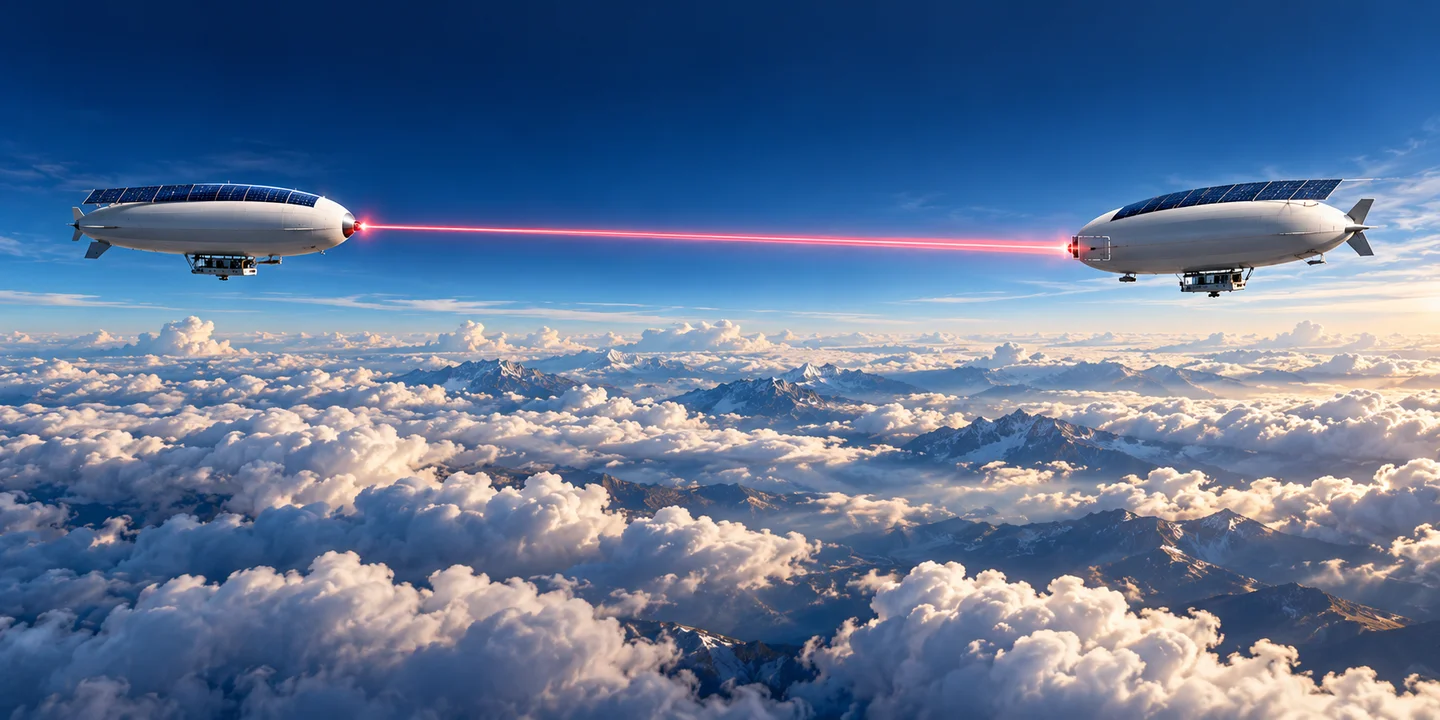
Inter-HAPS optical links can experience receiver saturation at short separations and become signal-to-noise-ratio (SNR) limited at longer distances. This work proposes a saturation-aware spatial multi-branch intensity-modulation/direct-detection receiver using nonoverlapping apertures with progressive attenuation and selection of the nonsaturated branch with the highest instantaneous SNR. A Gaussian-beam model with finite-aperture pointing loss and common two-dimensional pointing jitter yields closed-form branch-level expressions for saturation, insufficient-SNR, usability, and outage probabilities. Results show that additional branches suppress short-range saturation outage, shift the minimum-outage point toward shorter separations, and enable progressive attenuation to control the saturation–SNR tradeoff. Monte Carlo simulations closely match the analytical results. Overall, the proposed architecture provides a low-complexity approach to extending the usable dynamic range of inter-HAPS optical receivers.
ENGINEERING QUESTION
How can an optical receiver survive both too much light and too little signal?
At short inter-HAPS distances, strong received light can saturate a detector. At longer distances, beam spreading and pointing error can leave too little signal. This receiver gives separate apertures progressively stronger fixed attenuation, then selects the highest-SNR branch that remains linear. In the reported 50 km comparison, five branches reduce simulated outage from approximately 0.92 for one aperture to 0.11.
Give each aperture a different operating range
The receiver is a spatial array of separate, nonoverlapping circular collection apertures. Each aperture feeds its own attenuator and identical photodetector/front end, followed by DC blocking. The configurations studied contain one to five apertures: a centered aperture, a pair, a three-aperture line, a four-aperture square, and a center with four surrounding apertures.
Branch 1 has unit transmission. Each subsequent branch has progressively stronger fixed attenuation, following αₖ = ρᵏ⁻¹ for 0 < ρ < 1. Strongly attenuated branches provide headroom when optical loading is high; lightly attenuated branches preserve sensitivity as received power falls. The architecture uses spatial collection rather than splitting one collected beam, and does not require continuously adjusted attenuation or detector-mode switching.
Manuscript · Sections I–II; Fig. 1; Eqs. (1)–(9)
Select the best branch that remains linear
Saturation depends on the peak optical load reaching the photodetector or analog front end, including desired DC bias, modulation and background light. Removing DC after photodetection does not undo detector saturation, and the background shot-noise fluctuations remain after DC blocking.
For every common two-dimensional pointing realization, the receiver first excludes saturated branches and then selects the remaining branch with the greatest instantaneous electrical SNR. Spatial coupling differs between apertures, so selecting by attenuation coefficient alone is insufficient. Operation is valid only when the selected branch also meets the minimum SNR; otherwise the model distinguishes all-branches-saturated outage from insufficient-SNR outage.
Manuscript · Sections II-B–III; Eqs. (10)–(16)
Keep the shared pointing error in the outage model
A Gaussian beam, finite-aperture coupling and Gaussian angular jitter determine each aperture’s collected signal. A usable branch must avoid a high-coupling saturation region while remaining within a sufficiently strong-coupling SNR region. The paper derives closed-form marginal saturation, insufficient-SNR, usability and outage probabilities using the Rician displacement distribution and Marcum-Q function.
Every aperture experiences the same random beam-center displacement, so its pointing gain is correlated with the other branches. System outage is therefore evaluated over the joint two-dimensional pointing plane. Multiplying individual branch outage probabilities would lose this dependence; the full-system expression is a joint probability integral, rather than the branch-level closed form.
Manuscript · Section III-A–C; Eqs. (17)–(30)
What the numerical comparisons show
The numerical baseline uses 1550 nm light, a 0.021 m beam waist, 4 W DC bias, a 0.2 W signal scale, optical efficiency 0.5, 0.10 m aperture radius and 0.45 m center spacing. Detector responsivity is 0.85 A/W, background power 50 nW, electrical noise bandwidth 10 GHz, per-axis pointing-jitter standard deviation 10 µrad, and minimum SNR 25 dB. Figures 2–3 use a 5 mA saturation threshold; Monte Carlo comparisons use 200000 common pointing realizations.
In the reported distance comparison at 50 km, total outage falls from approximately 0.92 with one aperture to 0.11 with five branches. At 100 km, the reported total outage is approximately 1.46 × 10⁻⁵, 1.27 × 10⁻⁵ and 9.53 × 10⁻⁶ for three, four and five branches respectively. More branches shift the minimum-outage region toward shorter separation; at longer distances, reduced coupling increasingly makes SNR the limiting factor.
For the four-aperture square, reducing the progression factor strengthens attenuation in the later branches and moves the saturation-to-reliable-operation transition toward shorter distances. The distance–attenuation sweep reports a minimum outage of approximately 3.7 × 10⁻⁶ under the modeled conditions.
A separate branch-usability comparison uses four branches, ρ = 0.6 and a tighter 2 mA saturation threshold. At 50 km, usability rises from about 0.15 for Branch 1 to 0.89 for Branch 4. At 300 km, the ordering reverses: the reported usable probabilities are approximately 0.953, 0.933, 0.905 and 0.865 for Branches 1–4. Analytical and Monte Carlo branch-usability curves agree with maximum absolute error below 1.9 × 10⁻³.
Manuscript · Section IV; Figs. 2–4
Engineering relevance and model boundaries
The contribution is a low-complexity receiver strategy for widening optical dynamic range across changing inter-HAPS distances. The analysis and simulation identify complementary operating regions for fixed attenuation levels; they do not establish a universal attenuation setting or a measured communications-throughput gain.
The adopted clear-air stratospheric model omits turbulence-induced scintillation and uses a background-shot-noise-limited baseline. Thermal noise, dark-current noise, desired-signal shot noise, relative-intensity noise, quantization noise and amplifier noise are excluded. The reported results are numerical, without a demonstrated airborne receiver or field deployment.
Manuscript · Sections II-A–B and V
Publication record
- Authors
- Meysam Ghanbari, Betul Beidas, Wasiu O. Popoola, Mazen O. Hasna, Khalid A. Qaraqe, Mohammed Elamassie
- Venue
- 2027 IEEE Vehicular Technology Conference (VTC2027-Spring)
- Location
- Hamburg, Germany
- Status
- Accepted
- Year
- 2027
The abstract, full author order, architecture and numerical results follow the supplied arXiv:2609.13603v1 manuscript dated 11 September 2026. Accepted status and Meysam Ghanbari’s forthcoming IEEE VTC 2027-Spring presentation in Hamburg are confirmed by the author. Conference dates are 20–23 June 2027; an individual session time and proceedings DOI are not yet recorded. The technical explanation is editorial and separate from the original abstract. Research note updated 2026-10-10.