Abstract
Original text · supplied arXiv v1 manuscript (22 September 2026)
Fine tracking in inter-satellite optical links must compensate residual line-of-sight (LOS) motion despite sensor noise, vibration, model mismatch, and actuator latency. This paper develops a receiver-side physics-informed residual digital twin (PIR-Twin) that combines a nominal LOS transition, Gaussian optics, a nonlinear quadrant-photodetector observation, and extended Kalman filter synchronization. A normalized autoregressive ridge model learns the transition mismatch from independent calibration estimates, while the known delayed fine-steering-mirror correction remains separate from the physical LOS dynamics. The synchronized twin predicts the LOS at the command-actuation instant and enables proactive fine tracking. A controlled evaluation compares open-loop, reactive, nominal-predictive, and PIR-Twin operation using disjoint tuning, calibration, and test realizations. Under the nominal scenario, PIR-Twin reduces RMS pointing error by 14.1% relative to reactive tracking and also improves actuation-time prediction accuracy. Extended robustness tests show that the proposed method retains the lowest mean pointing error over a broad actuator-delay range and under increased time-varying LOS-motion amplitudes without residual-model retraining. The results demonstrate that correcting systematic short-horizon model mismatch, rather than relying on nominal extrapolation alone, is the key mechanism enabling effective predictive fine tracking.
ENGINEERING QUESTION
What if a satellite optical receiver could predict where the beam will be when its steering command takes effect?
PIR-Twin forecasts the line of sight at the actuator’s future application time, combining a nominal physical model with a learned correction for short-horizon mismatch. In the simulated 1000 km link at 2 ms actuator delay, mean pointing RMS falls from 2.12 µrad with reactive tracking to 1.82 µrad. The gain comes from correcting prediction error, while the steering mirror’s delayed optical correction stays separate from spacecraft motion.
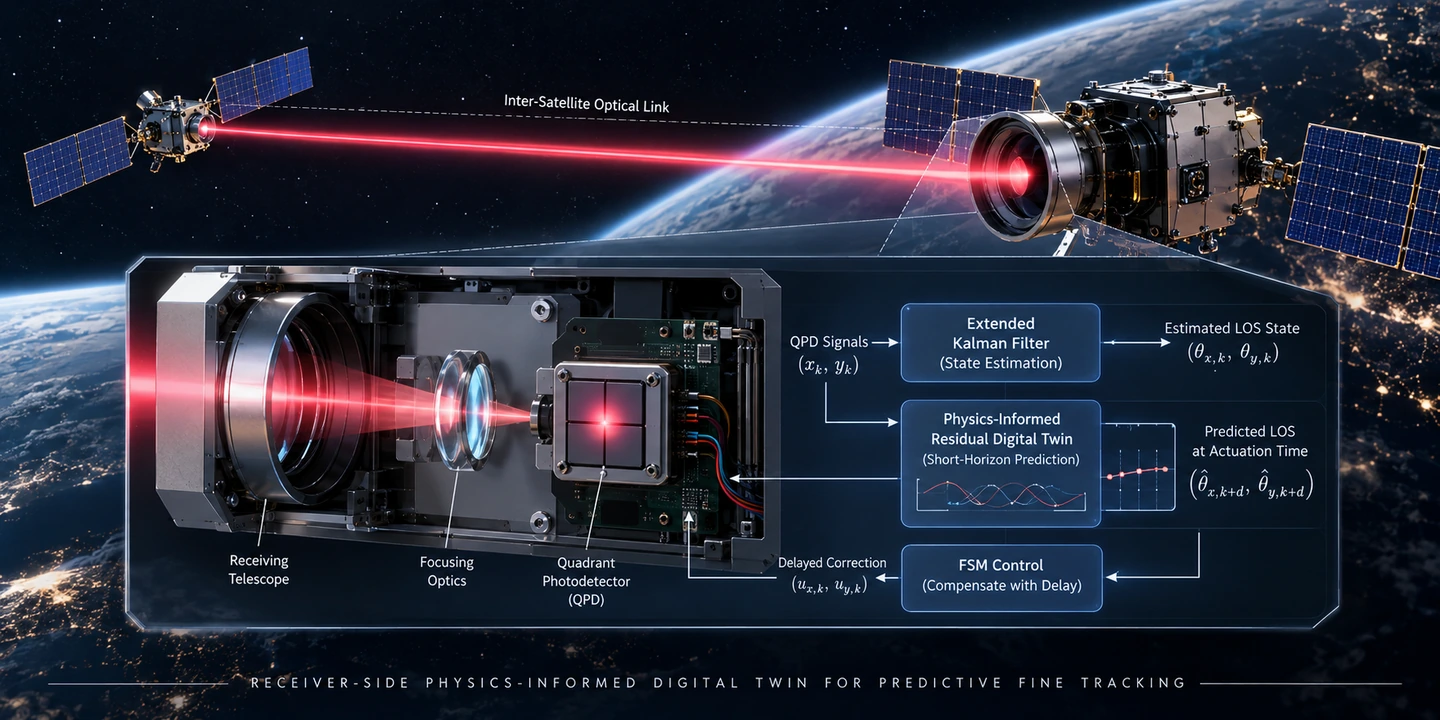
Track the beam at actuation time
After coarse acquisition and point-ahead compensation, a receiver must suppress residual line-of-sight motion within its fine-tracking range. Sensor noise, vibration and actuator latency mean that an accurate estimate of the beam’s current angle may already be out of date when a steering correction takes effect.
The architecture combines quadrant-photodetector sensing, an extended Kalman filter (EKF), nominal LOS dynamics, a residual predictor and a delayed fine-steering-mirror (FSM) command queue. The EKF estimates uncompensated LOS motion using the known correction currently applied to the optics. An FSM command changes the optical pointing geometry; it does not accelerate the spacecraft or enter the physical LOS transition.
Manuscript · Sections I–II; Fig. 1; Eqs. (1)–(14)
Learn the mismatch and preserve the physical model
A constant-angular-rate model supplies the nominal transition. A normalized autoregressive ridge regressor learns only its residual mismatch, using consecutive synchronized EKF posterior estimates from separate calibration traces. It does not receive the true simulated state during fitting.
The predictor rolls the nominal transition and a bounded learned residual forward over the command delay. Pending commands remain known optical offsets. The same nominal EKF, gain, actuator authority and measurement noise are retained across reactive, nominal-predictive and PIR-Twin modes, isolating the contribution of improved forecasting.
Tuning uses a separate 2 s trace. Four independent 5 s calibration traces yield 18000 valid transition samples after discarding the initial 0.5 s of each trace. The learned weights are fixed before testing on ten unseen 2 s realizations.
Manuscript · Section III; Eqs. (15)–(34); Section IV-A
Controlled simulation results
The model uses a 1000 km link at 1550 nm, a 30 mm beam waist and a 16.45 µrad Gaussian half-angle, with a 100 mm receive aperture. Fine tracking operates at 1 kHz, nominally with a 2 ms delay and ±50 µrad per-axis correction authority. The independently generated LOS trajectories include bias, drift, vibration and randomized low-frequency tones.
At the nominal 2 ms delay, Table I reports mean two-axis pointing RMS of 25.7 ± 0.6 µrad open loop, 2.12 ± 0.08 µrad reactive, 2.11 ± 0.08 µrad nominal predictive, and 1.82 ± 0.11 µrad PIR-Twin. The reported ± values are sample standard deviations across ten test seeds. The manuscript reports a 14.1% improvement over reactive tracking from its unrounded results.
Actuation-time prediction RMSE falls from 1.95 ± 0.01 µrad for reactive tracking to 1.62 ± 0.05 µrad for PIR-Twin. Its equivalent Gaussian angular penalty falls from 0.125 to 0.088 dB, with similar applied-command amplitudes. This optical-quality proxy is not a measured received-power or communications-throughput result.
Manuscript · Section IV-A–C; Table I; Eqs. (35)–(41)
Robustness and boundaries
The fixed residual model has the lowest mean pointing error across the tested 1–12 ms delays and 1×, 1.5× and 2× time-varying LOS-motion amplitudes. At 12 ms under nominal motion, pointing RMS is 12.56 µrad for nominal prediction, 6.33 µrad reactive and 5.94 µrad PIR-Twin. The stronger-motion tests increase the reported 2 ms improvement over reactive tracking to 20.7% and 23.7%, without retraining.
These are controlled numerical results. The QPD observation assumes sufficiently large detector area, negligible quadrant gaps and fixed normalized measurement covariance. The actuator is represented by an effective fixed delay and finite angular authority. The work does not demonstrate on-orbit hardware, field robustness to every disturbance, or end-to-end data-rate gains.
Manuscript · Section II-B; Section IV-D; Fig. 2; Section V
Publication record
- Authors
- Mahtab Dashtebozorgi, Meysam Ghanbari, Rula Ammuri, Mazen O. Hasna, Khalid A. Qaraqe
- Planned presentation
- The 9th International Conference on Advanced Communication Technologies and Networking (CommNet 2026)
- Location
- Rabat, Morocco
- Status
- Preprint
- Year
- 2026
- Preprint date
- 2026-09-22
The abstract, author order and technical results follow the supplied arXiv:2609.25975v1 manuscript dated 22 September 2026. Meysam Ghanbari has confirmed plans to present this work at CommNet 2026 in Rabat, Morocco. A conference acceptance, session slot, proceedings publication and DOI have not been verified. The technical explanation is editorial and separate from the original abstract. Research note updated 2026-10-10.